
If you want to know how to validate a business idea, ignore the Twitter threads that start with “just ship.” Shipping is expensive when the problem is imaginary. The cheaper move is to test your idea until someone who does not love you spends time or money.
This is not the 48-hour sprint (that playbook lives here). This is the field guide: what validation is, what the failure data actually says, and the ladder from “my friends like it” to “a stranger paid.”
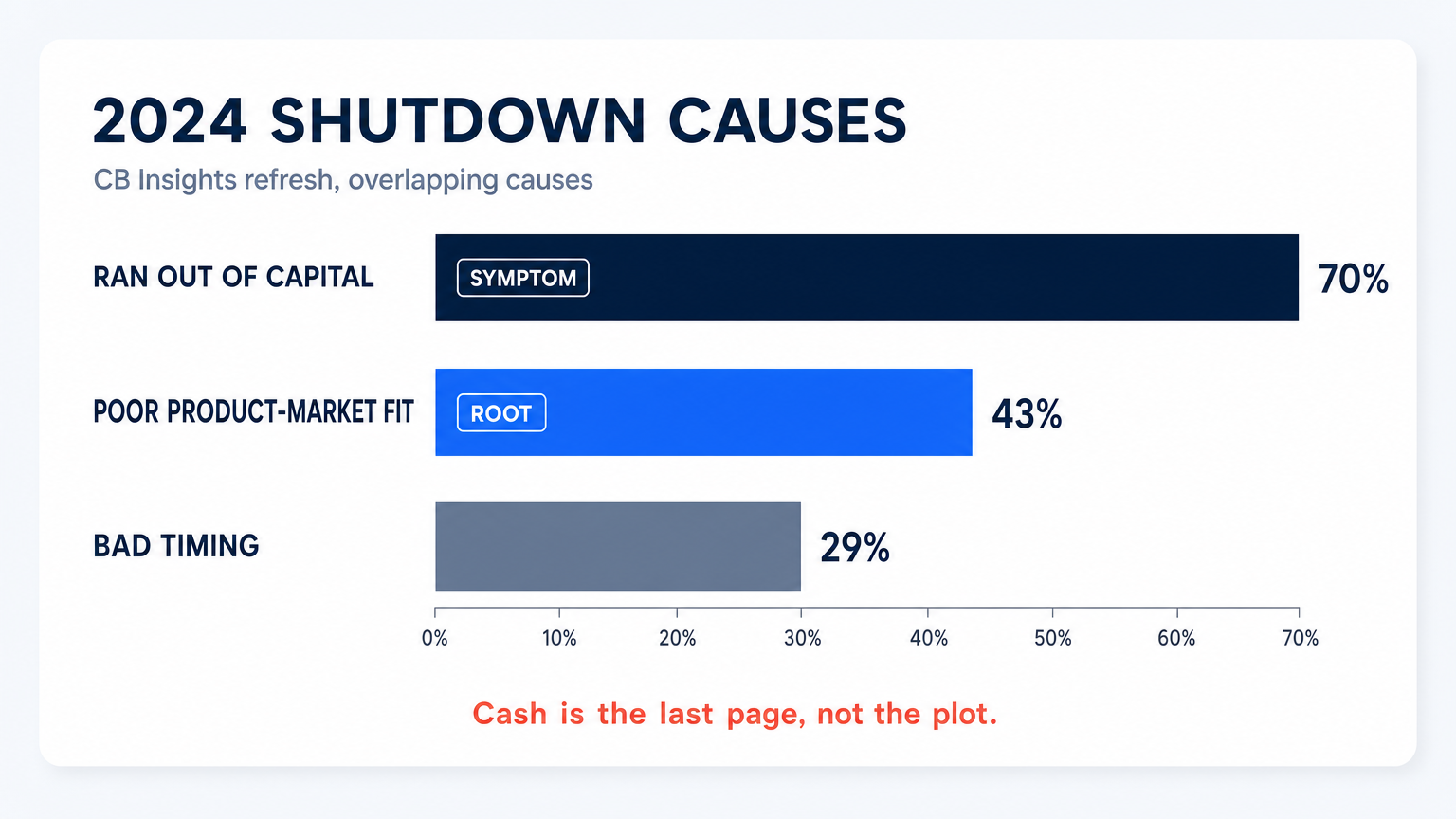
43%
Poor PMF in 2024 shutdowns
70%
Ran out of cash (symptom)
5 rungs
On the evidence ladder
6
MVI evidence pillars
What the failure data is (and is not)
The famous “42% failed for no market need” number comes from CB Insights’ older set of 101 post-mortems. In the 2024 refresh, researchers looked at 431 VC-backed companies that shut down after the rate shock. “Ran out of capital” shows up in 70% of stories because that is how companies die. The more useful causes underneath: poor product-market fit (43%), bad timing (29%), unsustainable unit economics (19%). Causes overlap. Nobody fails for a single pie-slice.
Translation for founders: if you cannot show that a specific buyer will pay to make a specific pain go away, more code will not save you. An idea validation tool is useful when it attacks that gap. It is harmful when it congratulates the pitch.
The evidence ladder
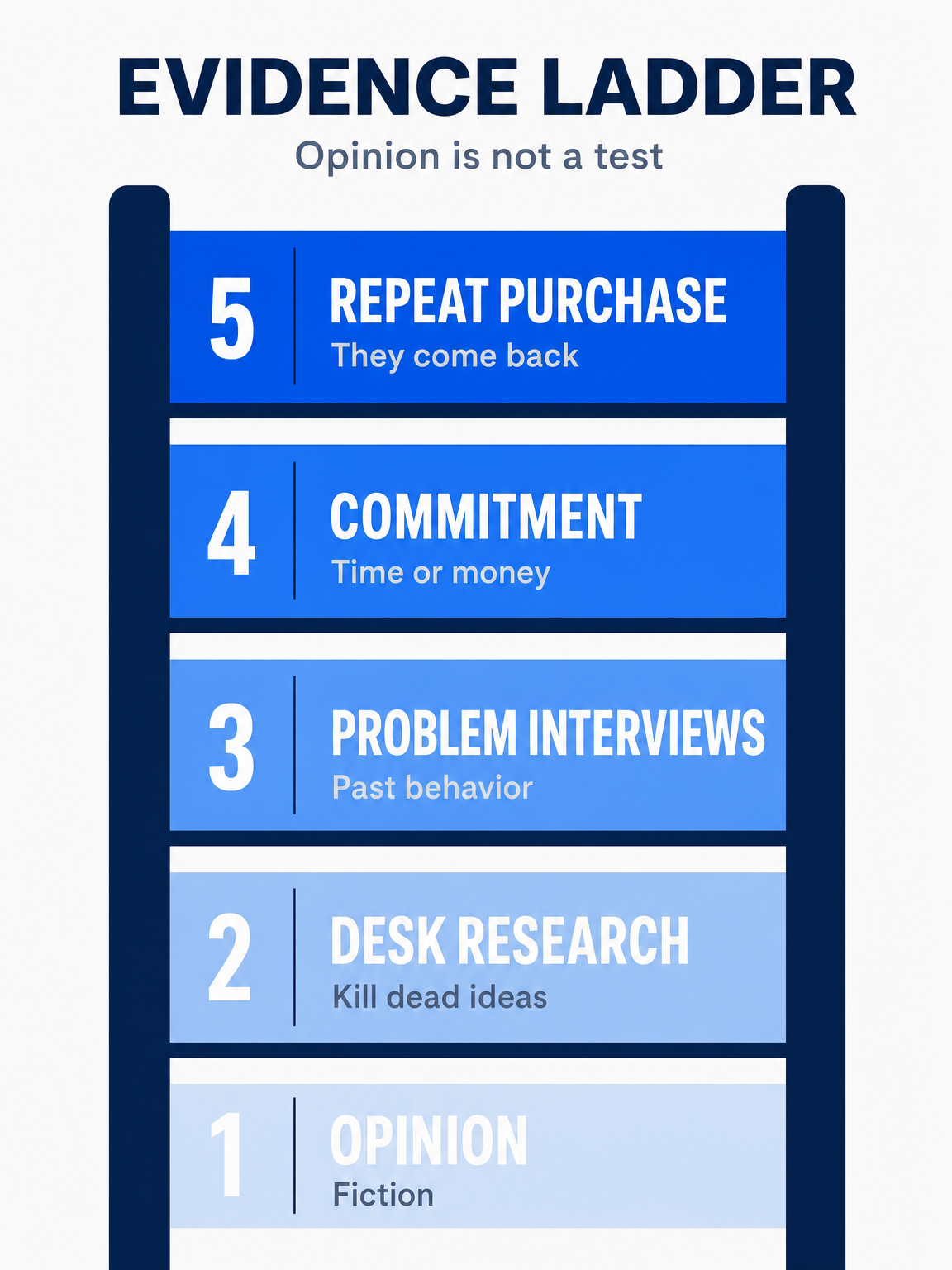
- Opinion. Yours, your co-founder’s, ChatGPT’s. Treat as fiction.
- Desk research. Search volume, competitor pricing, regulation, switching costs. Useful to kill obviously dead ideas. Not sufficient to confirm a live one.
- Problem interviews. Past behavior, not hypotheticals. “Tell me the last time this broke” beats “would you use X?” See our interview guide.
- Commitment. A calendar hold, a preorder, a letter of intent, a paid pilot. Time or money. Compliments do not count.
- Repeat. They come back, they expand seats, they introduce a peer. That is when you are approaching product-market fit, which is a later question than “is the problem real?”
How to test your idea this month
1. Write the riskiest assumption in one sentence
Not “people want healthier food.” Try: “Operations managers at 50–200 person manufacturers will pay $400/month to stop reconciling inventory in spreadsheets, and they have budget this quarter.” If you cannot name the buyer, the price, and the pain, you do not have a test yet.
2. Talk to 15 people who already have the pain
Recruit from communities you already belong to, not from “startup Twitter.” Ask for the last workaround. If they have no workaround, the pain is not expensive. If they have a painful workaround and no urgency, you have a vitamin.
3. Sell a manual version
Concierge the service in a spreadsheet or WhatsApp if you must. Airbnb’s early photography trick and Stripe’s founder-led integrations were ugly on purpose. Beauty is not validation.
4. Instrument the landing page like a salesperson
A waitlist is only a test if you ask one qualifying question and you follow up. Pageviews are not demand. Booked calls and card details are.
What NexTraction scores (MVI)
Market Viability Index is 0–100 evidence quality across six pillars: Problem Evidence, Solution-Market Fit, Audience Alignment, Differentiation, Market Momentum, Go-to-Market Story. It is not a prediction that you will raise or that you should not pivot. We use internal screenings (n=237) to calibrate what counts as evidence. If a pillar is empty, that is the research agenda for the week, not a moral failure.
Idea validation tool
See which pillars are stories and which are sourced.
Run MVI on the idea. Free to start. Then go talk to the humans the score still doubts.
Validate a business idea →When to kill, pivot, or proceed
- Kill if 15 target buyers do not have a workaround and will not take a follow-up. You learned cheap.
- Pivot the customer if the pain is real in a narrower ICP than you hoped. This is the most common honest win.
- Proceed only with a commitment artifact and a written next experiment. “We are encouraged” is not a gate.
FAQ
Is talking to friends validating a business idea?
Only if they are the buyer and they pay. Otherwise they are advising you on taste.
Do I need an idea validation tool?
You need a way to keep score so you do not move the goalposts. A spreadsheet works. Software helps when it forces citations. NexTraction is the latter.
Next
When the problem is real, you still have to find the first customers and, later, to know whether you have PMF. Continue with the first 100 customers and what product-market fit is.