

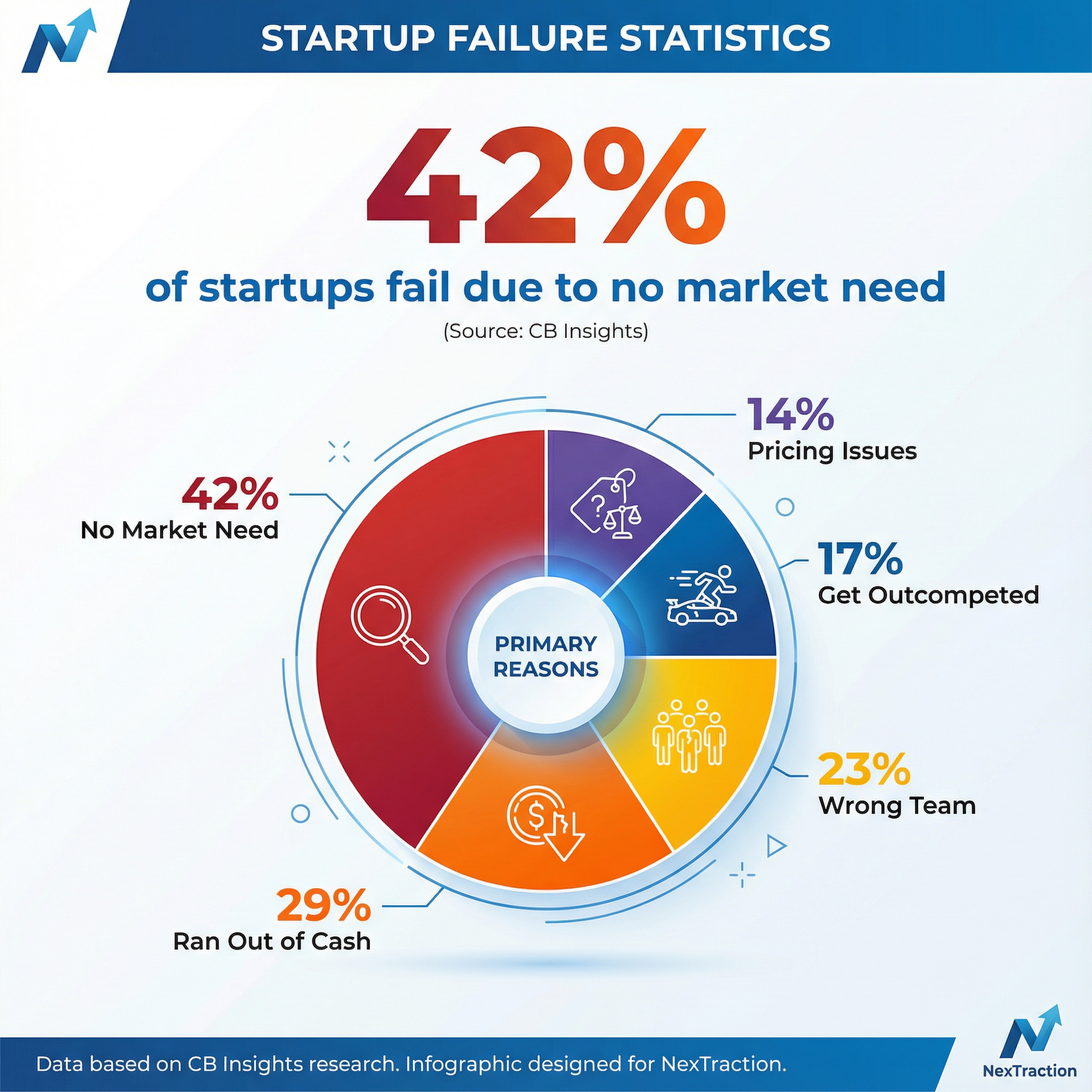
According to CB Insights, 42% of startups fail because there's no market need for their product. That's nearly half of all failed startups—not because of bad technology, poor execution, or lack of funding, but simply because they built something nobody wanted. The good news? This is entirely preventable with proper product-market fit validation.
Product-market fit (PMF) is the holy grail of startup success. But how do you know if you have it before investing months or years building a product? This comprehensive guide will show you exactly how to validate product-market fit in just 48 hours using a systematic, evidence-based framework.
42%
Fail on no market need
48 hrs
To disprove a bad idea
≥40%
Sean Ellis threshold
6 pillars
In the framework
What is Product-Market Fit? (Definition)
Product-market fit is the degree to which a product satisfies strong market demand. It's the point where your solution genuinely solves a problem that customers will pay to fix. Marc Andreessen, who coined the term, describes it as "being in a good market with a product that can satisfy that market."
You know you have product-market fit when:
- Customers are actively seeking out your product
- Word-of-mouth growth is happening organically
- Users would be "very disappointed" without your product (40%+ threshold)
- Your growth rate is accelerating, not plateauing
- Customer acquisition cost is sustainable relative to lifetime value
Why Product-Market Fit Validation Matters Before Building
The traditional approach to startups—build first, validate later—is fundamentally flawed. Here's why validating PMF before building is critical:
The Cost of Getting It Wrong
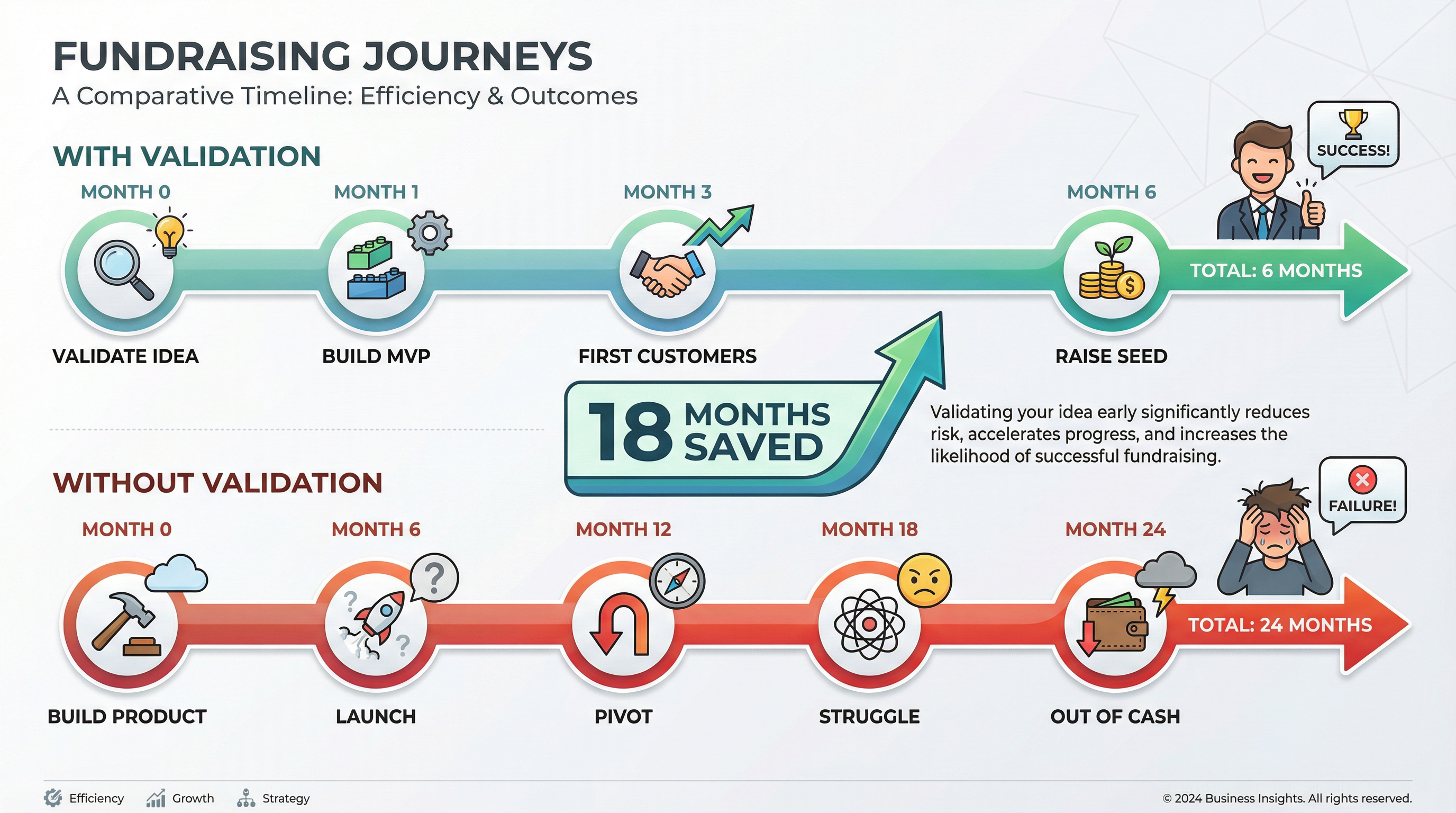
- Time waste: Average time to pivot is 12-18 months—time you can't get back
- Financial drain: Building the wrong product can cost $50,000-$500,000+ before you realize the mistake
- Opportunity cost: While building the wrong thing, you're missing the right opportunity
- Team morale: Pivoting after months of work is demoralizing for your team
- Investor confidence: VCs are 3x less likely to fund startups that haven't validated market need
The Benefits of Early Validation
- Confidence: Build with conviction knowing there's real demand
- Speed to market: Focus on features that matter, skip what doesn't
- Fundraising advantage: Validated startups raise 2x more funding on average
- Resource efficiency: Allocate limited resources to proven opportunities
- Competitive edge: Get to market faster than competitors who skip validation
The 48-Hour PMF Validation Framework
This framework is designed for founders who need to validate quickly without spending months on research. It's based on the NexTraction Market Validation Index methodology that has helped hundreds of founders make evidence-based decisions.
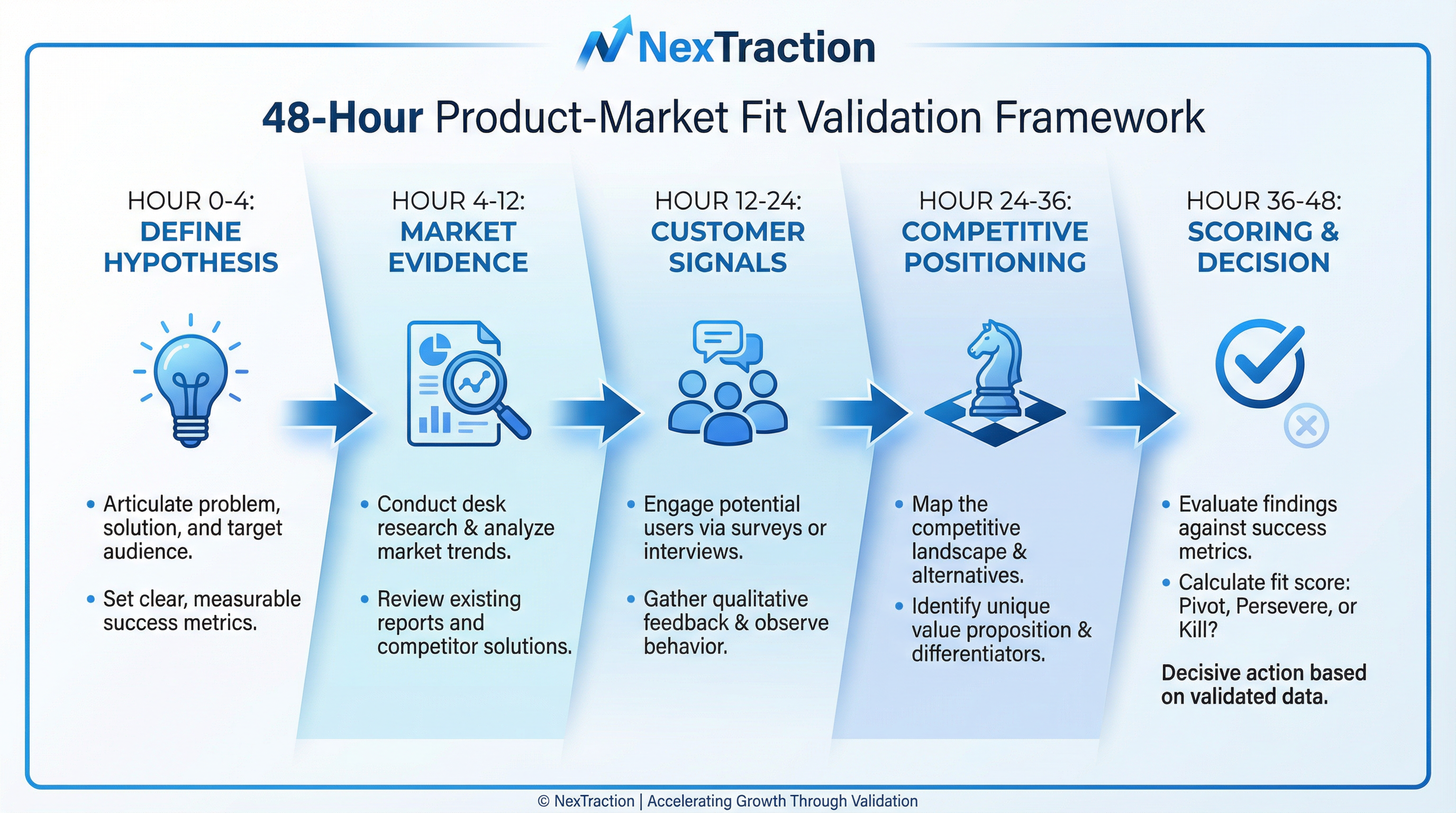
Hour 0-4: Define Your Hypothesis
Start by clearly articulating what you're testing. Vague ideas lead to vague validation.
Document these elements:
- Problem Statement: What specific problem are you solving? Be precise. "Small businesses struggle with accounting" is too broad. "Solo consultants spend 5+ hours per month on invoice tracking and payment follow-ups" is specific.
- Target Customer Profile: Who experiences this problem most acutely? Define demographics, psychographics, and behavioral characteristics. Create a detailed persona.
- Proposed Solution: How does your product solve this problem? What's the core value proposition? What makes it 10x better than alternatives?
- Success Metrics: What evidence would prove market need? Define specific, measurable criteria (e.g., "500+ monthly searches for solution keywords" or "20+ potential customers express willingness to pay").
Tools to use: Google Docs, Notion, or NexTraction's guided validation framework.
Hour 4-12: Market Evidence Gathering
Now validate that the problem exists at scale. You're looking for evidence that many people have this problem and are actively seeking solutions.
Search Volume Analysis:
- Use Google Keyword Planner, Ahrefs, or SEMrush to check monthly search volume for problem-related keywords
- Look for 1,000+ monthly searches as a minimum threshold for B2C, 100+ for B2B
- Analyze search trends: Is interest growing or declining?
Competitor Landscape Research:
- Identify 5-10 direct and indirect competitors
- Analyze their positioning, pricing, and customer reviews
- Look for gaps in their offerings—these are your opportunities
- Check their funding status on Crunchbase—funded competitors validate market interest
Online Community Research:
- Search Reddit, Quora, and industry forums for discussions about the problem
- Look for pain points, workarounds, and feature requests
- Join relevant Facebook groups, LinkedIn groups, and Slack communities
- Document common complaints and unmet needs
Hour 12-24: Customer Signal Collection
Direct customer evidence is the most valuable validation data. You need to hear from real potential customers.
Social Listening:
- Use tools like Twitter Advanced Search, Brand24, or Mention to find people discussing the problem
- Look for tweets like "I wish there was a tool that..." or "Why is [problem] so difficult?"
- Engage with these people—ask follow-up questions
Review Mining:
- Read 50-100 reviews of competitor products on G2, Capterra, App Store, or Amazon
- Look for patterns in complaints and feature requests
- Identify what customers love and hate about existing solutions
- Document exact quotes—these become your marketing copy later
Quick Surveys or Interviews:
- If you have access to potential customers, conduct 5-10 quick interviews (15 minutes each)
- Ask about their current solution, pain points, and willingness to switch
- Use the "Mom Test" framework: Ask about past behavior, not hypothetical future actions
- Gauge willingness to pay: "What would a solution to this problem be worth to you?"
Hour 24-36: Competitive Positioning Analysis
Understanding your competitive landscape is crucial for PMF validation. Even if you have a great product, you need a clear path to winning customers from alternatives.
Feature Comparison Matrix:
- Create a spreadsheet comparing your planned features vs. top 5 competitors
- Identify where you're better, worse, and different
- Look for "blue ocean" opportunities—underserved segments
Pricing Analysis:
- Document competitor pricing tiers and what's included
- Identify the "market price" for your category
- Determine if you can compete on price, value, or differentiation
Differentiation Opportunities:
- What can you do that competitors can't or won't?
- Is there a specific niche you can dominate?
- Can you offer a dramatically better user experience?
- Is there a business model innovation opportunity?
Hour 36-48: Scoring and Decision
Now synthesize all your research into a go/no-go decision using a structured framework.
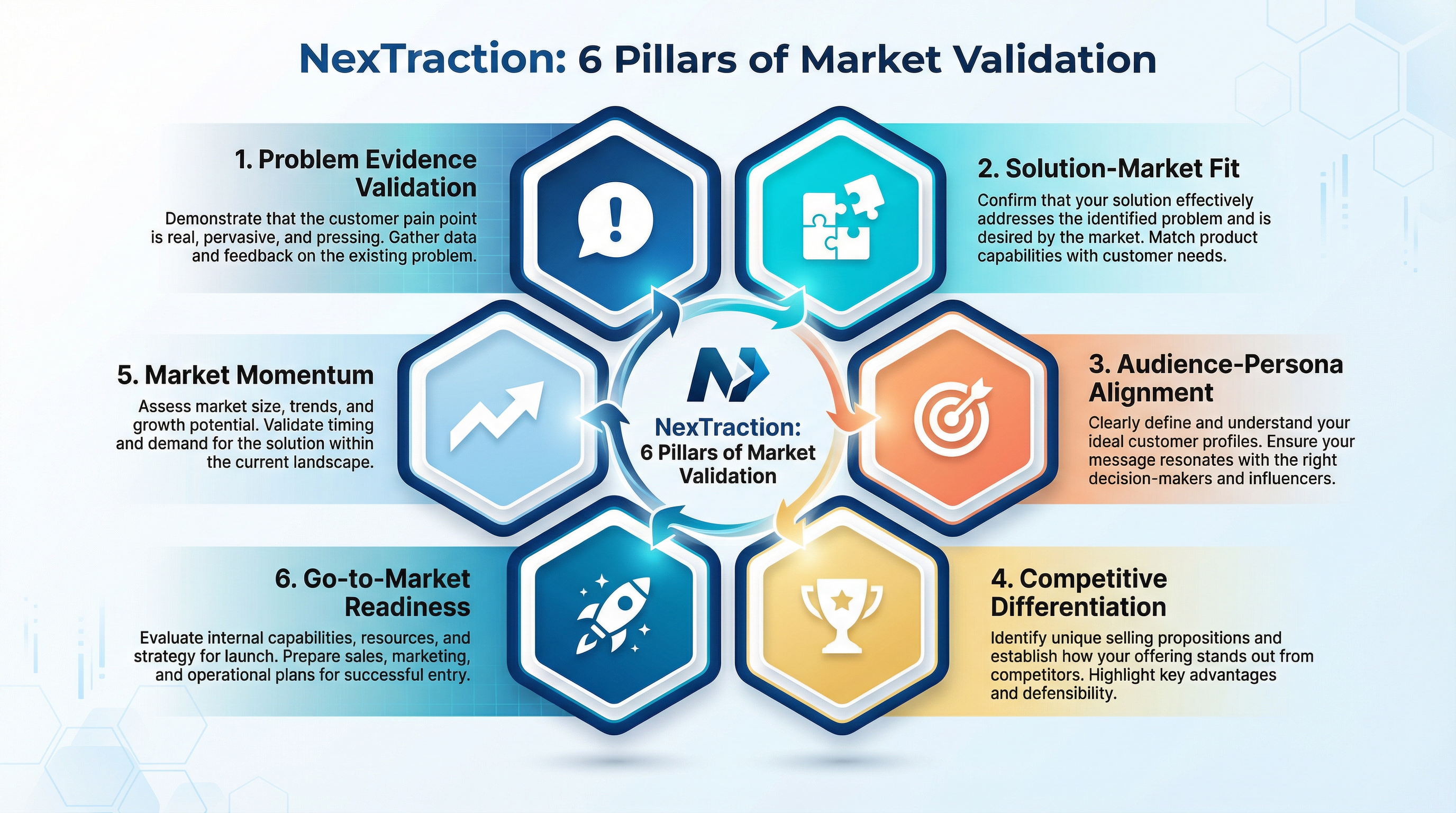
Use NexTraction's Market Validation Index framework to score each pillar (0-100):
- Problem Evidence: Is there clear evidence the problem is real and painful?
- Solution-Market Fit: Does your solution map tightly to that job?
- Audience Alignment: Who exactly has the problem, and does the story speak to that person?
- Differentiation: Why this, not the workaround or the incumbent?
- Market Momentum: Is the market moving toward this job, or away from it?
- Go-to-Market Story: How do you reach buyers, and does that channel story hold up?
Decision Framework:
- Score 80-100: Strong validation—proceed with confidence
- Score 60-79: Moderate validation—proceed with caution, address weak areas
- Score 40-59: Weak validation—pivot or significantly refine before building
- Score 0-39: No validation—do not build, explore different opportunities
80–100 · Strong
Strong validation across most pillars. Ready to start building.
60–79 · Solid
Solid foundation. Address one or two weak pillars first.
40–59 · Weak
Mixed signal. Refine the wedge or pivot before investing more.
0–39 · No fit
Don't build. Explore adjacent opportunities or kill the idea.
Validate a business idea with the same scorecard
Score your idea across the six MVI pillars in under an hour.
NexTraction is an idea validation tool that scores evidence quality on the same six product pillars this guide names, plus IRS for investor readiness. It is not a success prediction.
Run the idea validation tool →Tools That Help Accelerate Validation
The right tools can compress weeks of research into hours. Here are the most effective tools for rapid PMF validation:
AI-Powered Validation Platforms
- NexTraction: AI-powered Market Validation Index scoring, competitive analysis, and investor readiness assessment. Get a comprehensive validation report in minutes instead of weeks.
Research Tools
- Google Keyword Planner: Free search volume data
- AnswerThePublic: Discover questions people are asking
- SparkToro: Audience research and where to find your customers
- SimilarWeb: Competitor traffic analysis
Survey and Interview Tools
- Typeform: Beautiful surveys with high completion rates
- Calendly: Easy interview scheduling
- Zoom: Video interviews with recording capability
Common PMF Validation Mistakes to Avoid
Even with a good framework, founders make predictable mistakes. Avoid these pitfalls:
1. Asking Friends and Family (Confirmation Bias)
Your mom will love your idea. Your college roommate will say it's brilliant. This is not validation—it's confirmation bias. You need feedback from strangers who have the problem and would actually pay for a solution.
2. Focusing on Features, Not Problems
Don't ask "Would you use an app with features X, Y, and Z?" Ask "How do you currently solve problem A?" and "What frustrates you about your current solution?" Features are your answer to their problem, not the validation itself.
3. Ignoring Negative Signals
If 8 out of 10 interviews reveal that people have found acceptable workarounds, that's a signal. Don't dismiss it. The best founders pivot based on evidence, not stubbornness.
4. Moving Too Fast Without Evidence
48 hours is fast, but don't skip steps. If you can't find search volume, competitor activity, or customer interest in 48 hours, that itself is a signal that the market may not exist.
5. Validating the Wrong Thing
Validate the problem and market need, not your specific solution. Your solution will evolve, but if the problem isn't real or big enough, no solution will work.
FAQ: Product-Market Fit Validation
How do you know if you have product-market fit?
Signs include: organic word-of-mouth growth, users actively requesting features, low churn rate (under 5% monthly for SaaS), customers willing to pay without heavy discounting, and at least 40% of users saying they'd be "very disappointed" without your product (Sean Ellis test).
How long does it take to achieve product-market fit?
Most startups take 2-3 years to find true product-market fit. However, validation of the concept can be done in days or weeks before significant investment. Early validation dramatically increases your odds of eventually achieving PMF.
Can you measure product-market fit?
Yes. Common metrics include: Net Promoter Score (NPS) above 40, 40%+ of users saying they'd be "very disappointed" without your product (Sean Ellis test), organic growth rate above 20% month-over-month, customer acquisition cost (CAC) less than 1/3 of lifetime value (LTV), and retention cohorts that flatten (not declining to zero).
What's the difference between market validation and product-market fit?
Market validation happens before you build—it confirms there's a real problem and market demand. Product-market fit happens after you build—it confirms your specific product satisfies that demand. Validation is the hypothesis; PMF is the proof.
How many customer interviews do I need for validation?
For B2B: 15-20 interviews with decision-makers. For B2C: 30-50 interviews with target users. The key is pattern recognition—when you stop hearing new information, you've reached saturation. Quality matters more than quantity.
Can I validate without talking to customers?
You can gather market evidence without direct interviews (search volume, competitor analysis, review mining), but direct customer conversations provide the richest insights. At minimum, do secondary research first, then validate findings with 5-10 customer conversations.
Conclusion: Validate Before You Build
The 48-hour PMF validation framework gives you a systematic approach to de-risk your startup before investing significant time and money. While 48 hours won't give you perfect certainty, it will give you enough evidence to make an informed decision.
Remember: The goal isn't to prove your idea is right. The goal is to discover the truth about market demand as quickly as possible. If you find weak validation, that's not failure—it's success. You just saved yourself 12-18 months of building the wrong thing.
The best founders are evidence-driven, not ego-driven. They validate relentlessly, pivot when necessary, and only build when they have strong market signals.
Ready to validate your startup idea? Try NexTraction's AI-powered Market Validation Index to get your comprehensive validation score in minutes, not weeks. Our platform analyzes your idea across all six validation pillars and provides actionable recommendations to strengthen your market position.