

The first 100 customers are not a smaller version of a Series B growth engine. They are a research program that happens to produce revenue. If you skip rungs, you usually skip learning, then you buy ads for a message nobody wanted.
The pattern that keeps showing up in 2025–26 write-ups (Lightfield’s ladder, Theanna’s waitlist, founder-led outbound playbooks) is staged: people who know you, rooms where you already have standing, then a loop. Stripe’s early integrations, Product Hunt’s daily email to featured makers, Airbnb’s photographer offer: each was a rung, not a hack you can copy without the underlying gift.
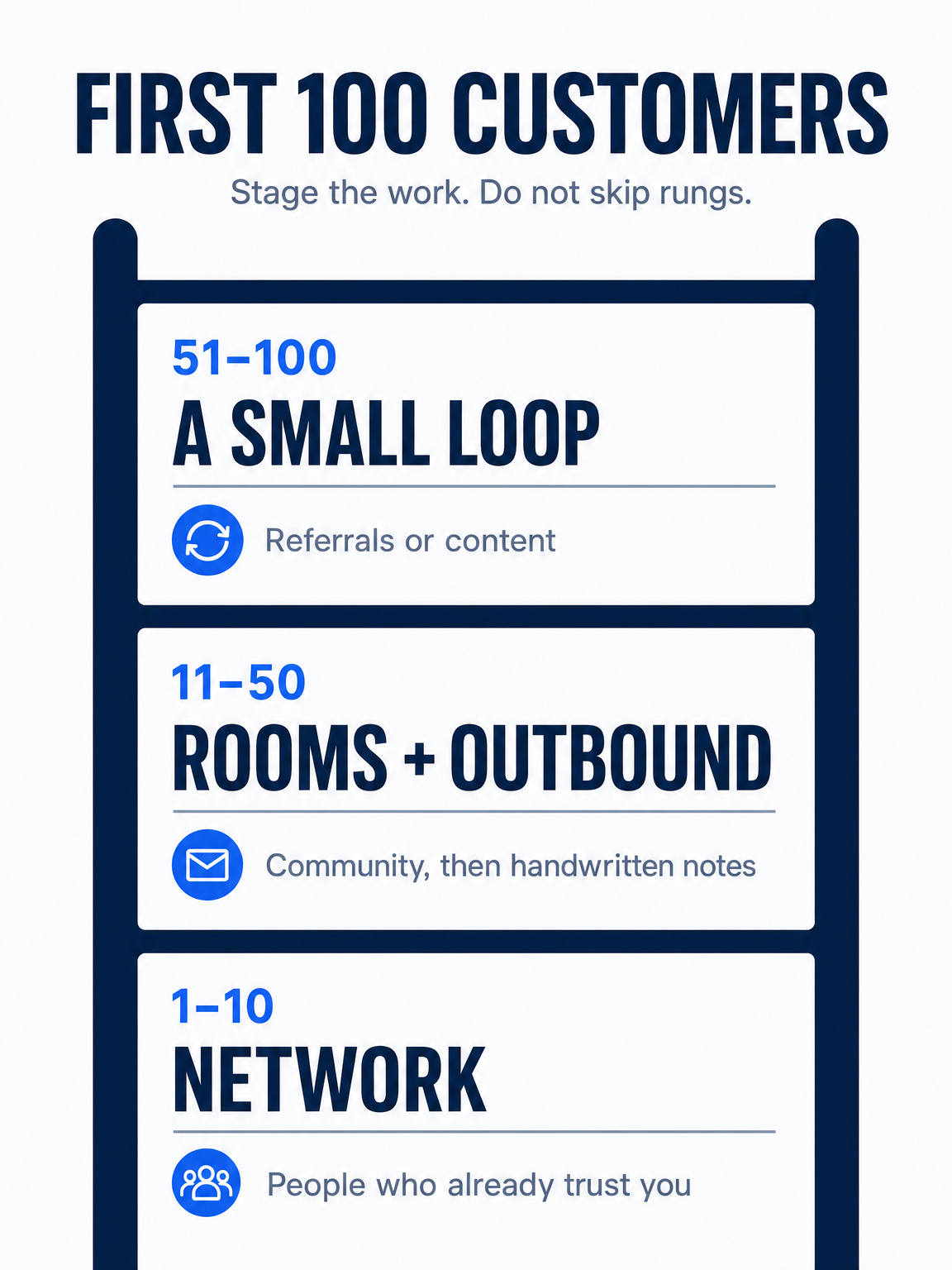
1–10
Network
11–50
Community + outbound
51–100
A small loop
10–30
Accounts in the founder queue
Rung 1: the first 10
List every person who already believes you are competent in this domain. Text them a specific ask: “I am helping ops leads cut weekly inventory reconciliation. Can I watch you do it once?” Do not blast a launch tweet and call it GTM. Theanna’s 100 paying customers in 60 days sat on a 950-person waitlist that was the same ICP, built in public for months. The conversion was earned before launch day.
Rung 2: 11–50, rooms and handwritten outbound
Pick one Slack, one subreddit, one association, or one geographic scene where the buyer already complains. Contribute for weeks. Then ask. Cold volume without standing is how you train the market to ignore you.
When you do outbound, keep the list short. Real Good GTM’s founder-led play: 10–30 accounts, about four touches in two weeks, first line written from a real artifact (a post they wrote, a hire, a product launch). Xi’s 50-message playbook is the same idea at slightly higher volume: research on Monday, send Tue–Thu, calls on Friday. Fifty thoughtful messages beat 500 sequences.
Rung 3: 51–100, a loop you can describe in one sentence
Examples that are loops, not vibes:
- Every successful week, ask for one introduction. Offer something concrete in return (extended trial, a teardown).
- A public artifact that attracts the same ICP (a benchmark, a calculator, a weekly email like early Product Hunt).
- A supply-side gift that improves the product for the next user (Airbnb’s photography is the canonical version).
If you cannot name the loop, you are still on rung 2. That is allowed. Pretending you are on rung 3 so you can hire a “growth lead” is how the first 100 stalls at 37.
What to measure
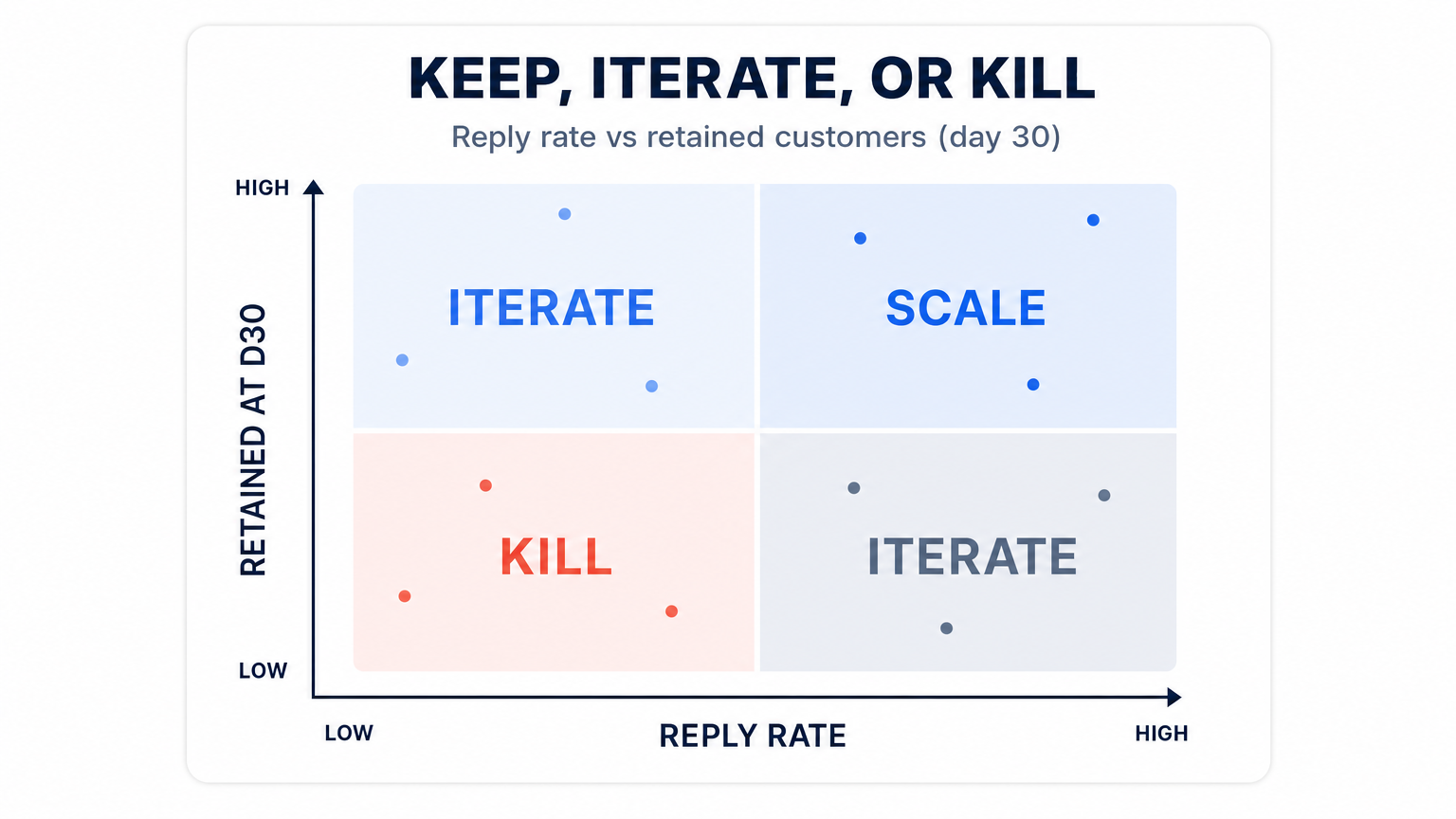
- Replies and booked calls, not sends.
- Paid conversions and 30-day retained customers, not signups.
- Which first line earned the reply. Keep a library of five, not a sequence of twelve.
- Which ICP actually stays. That is the input to PMF, not a vanity dashboard.
When paid ads are allowed
After the message is stable enough that a stranger can run it. Until then, ads buy you noise and a false CAC. Same rule for an SDR: hire when you can document the pitch, the ICP, and the objections from deals you already closed.
Before you scale the motion
Make sure the story you are selling is evidenced.
If the first 20 conversations keep dying on the same objection, that is a validation problem, not a CRM problem. Run MVI, then go back to the ladder.
Validate the idea →FAQ
Does this work for consumer?
The rungs still exist. Network becomes your scene. Outbound becomes creators and communities. Loops become sharing. Ads still wait until retention is not a sieve.
What if my network is not the buyer?
Then rung 1 is shorter and rung 2 starts immediately. Do not fake a network you do not have. Borrow standing by helping in the buyer’s room first.
Next
Customers without a true problem still churn. Pair this ladder with idea validation. When you are ready to tell the story to investors, build the deck from proof, not from the first 100 as a round number on a slide.