
Every founder thinks they're great at customer interviews. Most aren't. The reason isn't lack of effort — it's that the human brain is wired to confirm its own ideas. The questions you ask, the way you ask them, even the order you ask them in, all quietly nudge the answers toward "yes." This article shows you how to design interviews that actually find truth, with a script you can use tomorrow morning.
3
Questions to ban
20+
Interviews to saturation
35 min
Ideal interview length
90%
Listening time
The Mom Test, in one paragraph
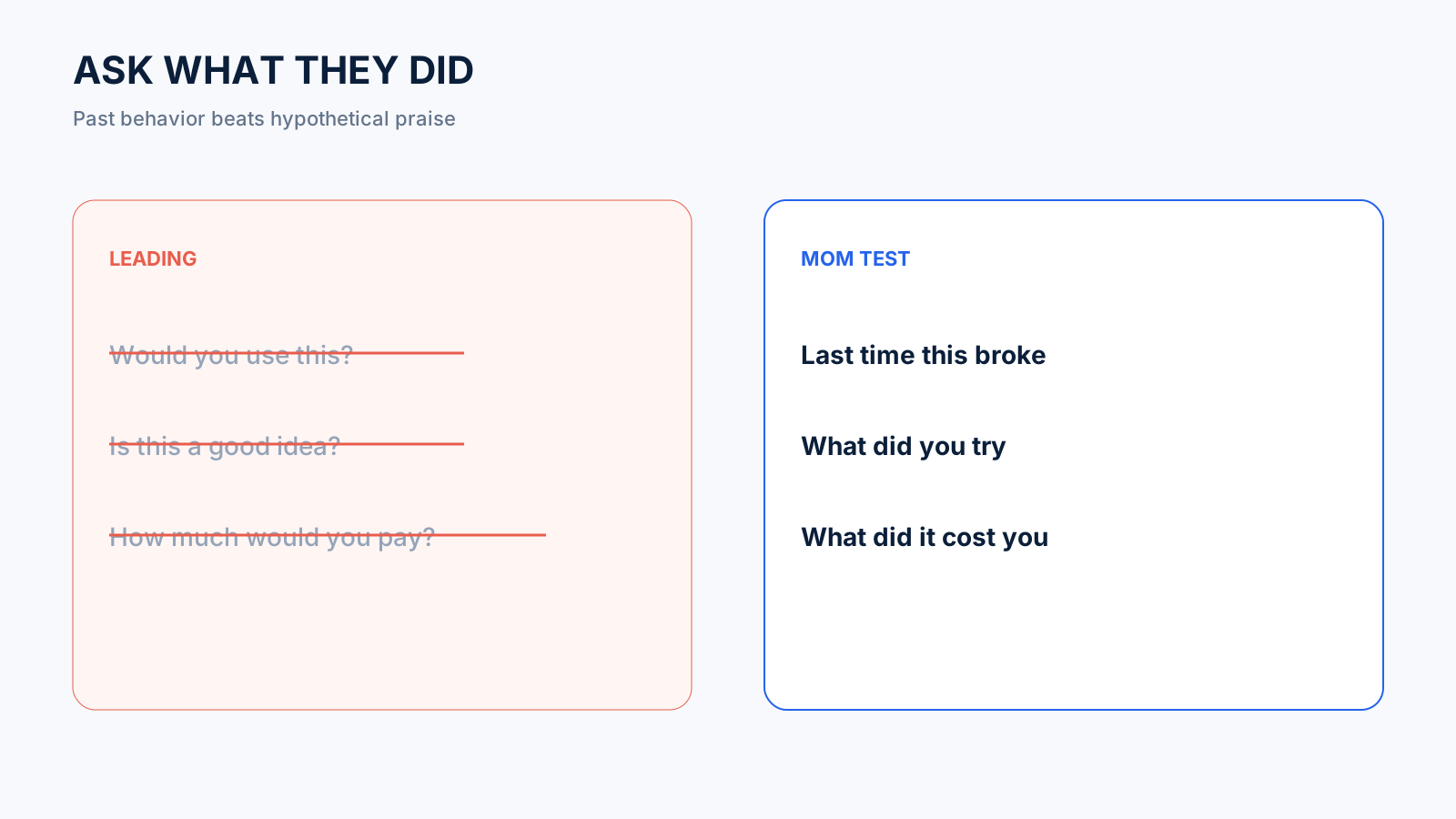
Rob Fitzpatrick's framework: your mom is the worst person to ask about your business idea, because she'll say it's brilliant out of love. The Mom Test rules apply to everyone, not just your mom: never ask leading questions, talk about their life rather than your idea, and ask about specifics from the past, not opinions about the future.
"Compliments are the fool's gold of customer development. They feel productive but contain zero information."
The 3 questions you need to ban
Banned: "Would you buy this?"
Politeness bias. The honest answer is "I don't know — maybe?" but they'll usually say yes. Replace with: "What did you spend on this last quarter?"
Banned: "Do you like this idea?"
They will, in fact, like the idea. Liking is free. Replace with: "What's the alternative you'd compare us to?"
Banned: "Wouldn't it be nice if…?"
The most leading question in startupland. Anything that follows "wouldn't it be nice" gets a yes. Replace with: "Walk me through the last time this happened."
The 5 questions that actually surface truth
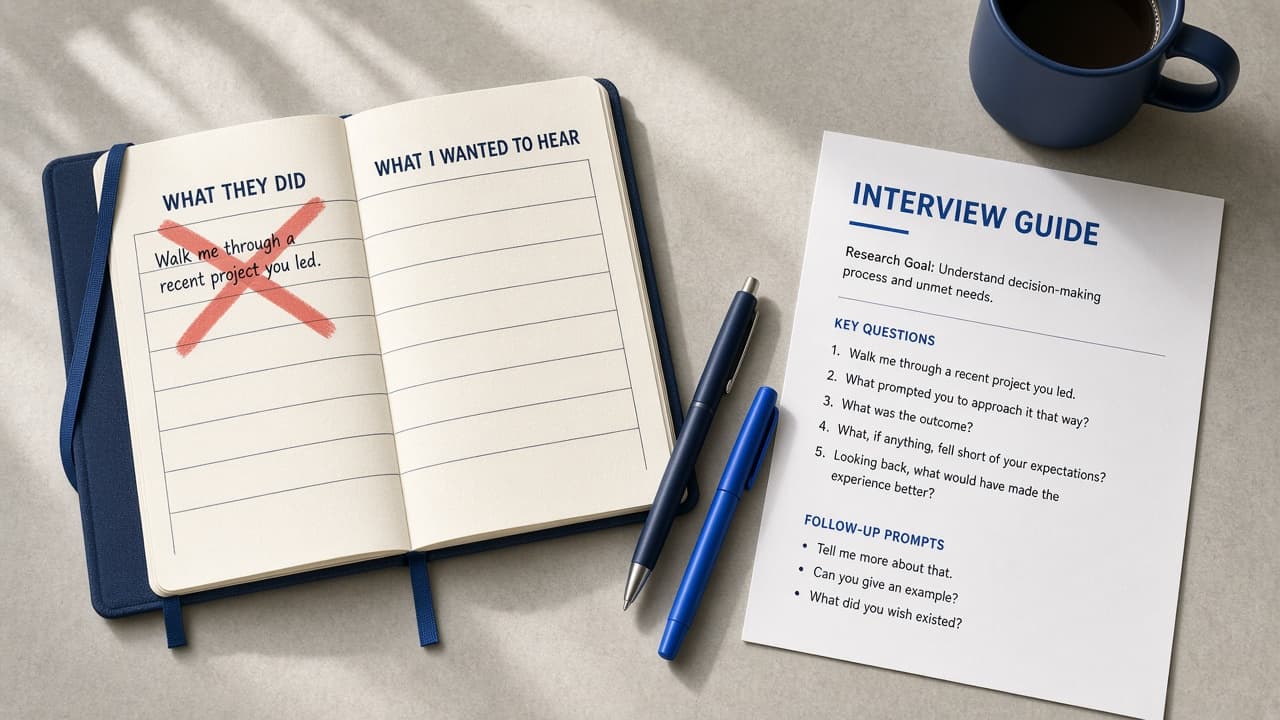
1 · "Walk me through the last time…"
Anchors the conversation in past behavior, not future intent.
2 · "What did you do then?"
Forces specifics. Real workflows have texture; imagined ones don't.
3 · "What did you spend?"
Time, money, attention — anything tradeable surfaces real priority.
4 · "What did you almost do instead?"
Reveals the real competitor (often "do nothing," which is the hardest one to beat).
5 · "What was the hardest part?"
Surfaces the actual job-to-be-done, not the surface-level annoyance.
6 · "Who else did this affect?"
Maps stakeholders. B2B sales rarely involve only one decision-maker.
The 35-minute structure
| Phase | Time | Goal |
|---|---|---|
| Warm-up | 5 min | Get them comfortable, learn their context |
| Problem story | 15 min | Walk through last time the pain happened, in detail |
| Current solutions | 10 min | What they tried, what they spent, what didn't work |
| Concept reveal (only at end) | 5 min | Brief mention of your idea — and watch their reaction, don't ask for opinion |
Signals to listen for
Strong signals
- They name a specific dollar amount they spent
- They show you their current workaround (a spreadsheet, a Slack thread)
- They ask when they can have your product
- They volunteer to introduce you to others
Weak signals (ignore)
- "That sounds great"
- "I would totally use that"
- "You should talk to my friend Bob"
- "What's your timeline?" (with no commitment behind it)
Practice the script first
Run your interview script against simulated personas before the real call.
NexTraction's persona panel will push back on leading questions and surface the answers a real customer would dodge. Founders who practice 8+ simulated rounds report 3–5× sharper signal in real interviews.
Practice with a panel →FAQ
How many interviews until I can stop?
Saturation is the answer — not a number. You'll know you've hit it when you can finish their sentence before they do, two or three interviews in a row. That usually happens around 20–25 interviews for B2B and 30+ for B2C.
Should I record interviews?
Yes, with permission. Memory is biased. Listening to the playback later will reveal subtleties you missed in the moment.
What if a great interview disagrees with my hypothesis?
Trust the interview. One specific, concrete data point from a real customer beats five months of internal certainty. Pivot the hypothesis, not the customer.
Conclusion
Customer interviews are the cheapest insurance you can buy on a startup idea — but only if they're done with discipline. Ban the leading questions, anchor every conversation in past behavior, and listen for the silences. Practice your script with a structured panel before booking the first real call.