


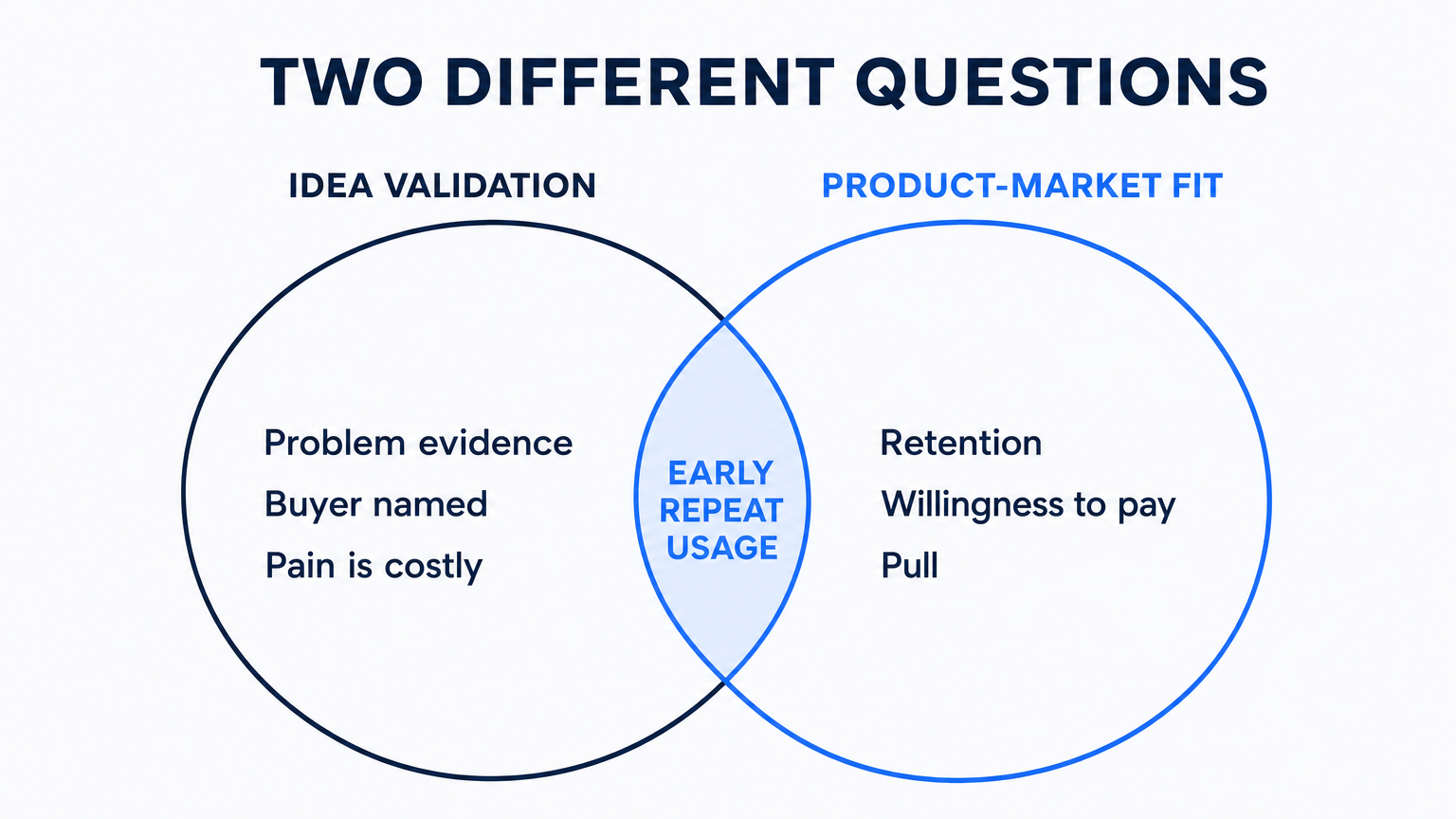
People ask “what is product market fit” when they mean two different things: “is anyone in pain?” and “does this product create pull?” The first is idea validation. The second is PMF. Mixing them is how teams scale a concierge that only works because the founder is in Slack 18 hours a day.
Marc Andreessen described PMF as being in a good market with a product that can satisfy that market. You know it in operations before you know it on a slide: sales cycles shorten, users recruit users, you feel behind on onboarding instead of behind on convincing.
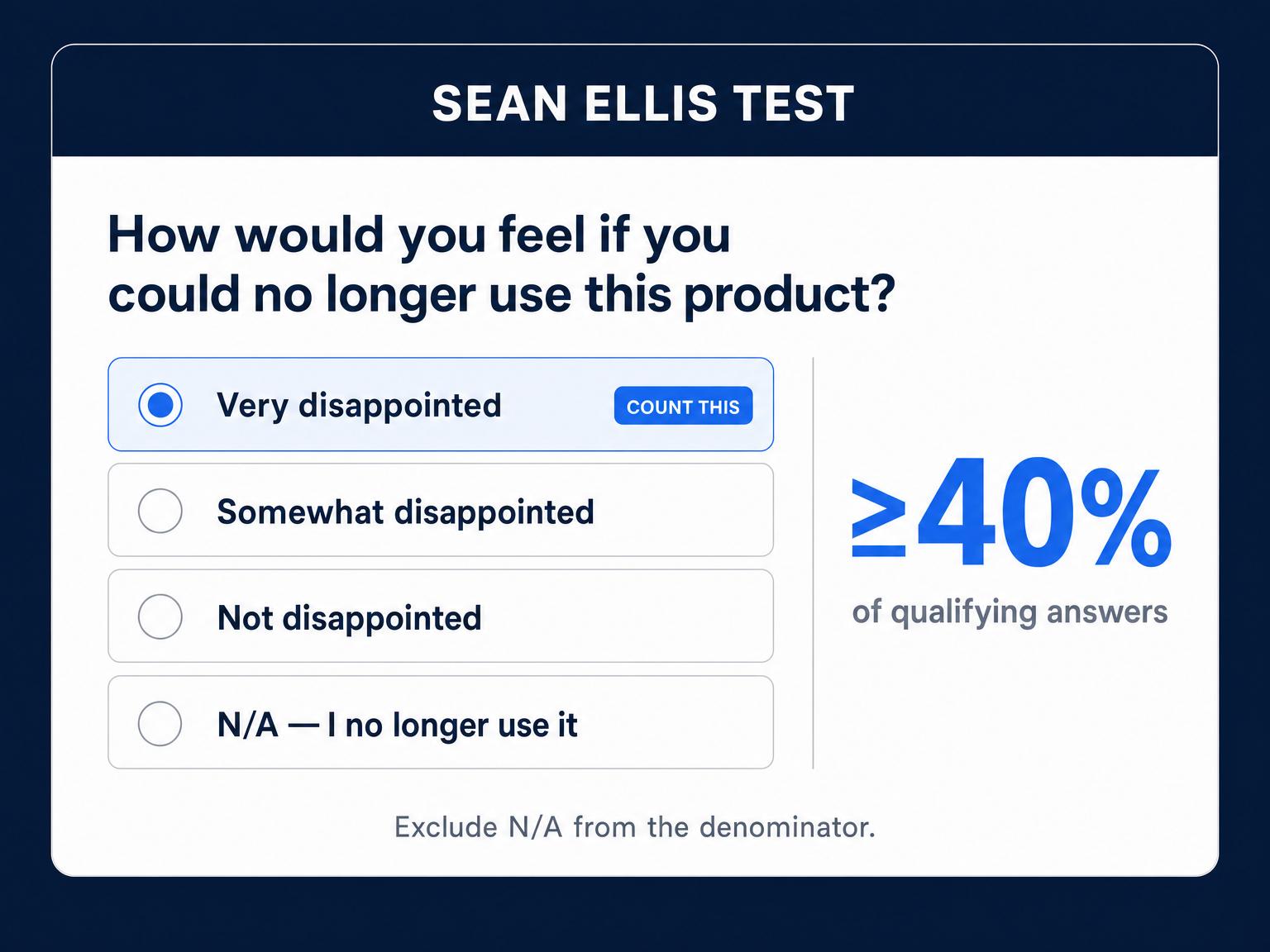
≥40%
Very disappointed (Ellis)
40–100
Responses to trust the survey
Flatten
Retention above zero
Pay
Or you do not have it
Definition, without the poetry
Product-market fit is the point where a defined product creates repeat demand in a defined market without heroics. Not “people said they would use it.” Not “we launched on Product Hunt.” Repeat demand: they come back, they pay, they would be upset if you disappeared.
How to validate PMF: the Sean Ellis test, done honestly
Ask engaged users: “How would you feel if you could no longer use this product?” Options: very disappointed, somewhat disappointed, not disappointed, N/A I no longer use it. Score = very disappointed ÷ qualifying responses (exclude N/A). Ellis found that products above about 40% tended to be able to grow; below that, paid acquisition leaked.
Rules that keep you from cheating:
- Survey people who used the product recently, not your waitlist.
- Need roughly 40 answers for a directional read, ~100 to trust it.
- Segment. 55% in one ICP and 12% in another is a targeting gift, not a blended “we are at 30%.”
- Track the score over time. Direction matters as much as a single number.
The 40% line is a heuristic from ~100 startups, not a law of physics. Companies have scaled from below it. Companies above it have still died on distribution or unit economics. Treat it as a leading indicator. Confirm with behavior.
Behavior that actually confirms PMF
- Retention that flattens. A cohort that does not decay to zero. The level depends on category (consumer social vs B2B workflow), so compare to your own past and to honest comps, not to a viral consumer app.
- Willingness to pay. Invoices, not survey “would you pay $49?”
- Organic pull. Inbound that you can explain (referral, search, community), not a single tweet.
- Sales that feel easier, not louder. Shorter cycles, fewer custom promises.
What PMF is not
- A launch week spike.
- A high NPS from friends and advisors.
- Press. Press is distribution, sometimes, and vanity, often.
- An MVI or IRS score. Those score evidence quality and investor-readiness. They do not certify PMF. Use them to see which story is unsourced, then go measure users.
Before you scale
Separate “problem is real” from “product has pull.”
Run MVI on the story, then look at retention and the Ellis question on real users. Free to start.
Validate the idea first →If you are under 40%
Do not buy more ads. Segment the very-disappointed users. Double down on that ICP, or change the product for them. Somewhat-disappointed users are a roadmap, not a market. Not-disappointed users are a polite no.
If you do not have 40 engaged users to survey, you do not have a PMF question yet. You have an acquisition and activation problem. Go get the first customers.
FAQ
Can I have PMF with zero revenue?
In consumer, sometimes, if retention and pull are violent. In B2B, if nobody pays, you have a hobby or a future procurement nightmare. Be careful with the story you tell investors.
How is this different from the “5 signs” article?
Five signs is a checklist of symptoms. This piece is the definition, the survey math, and the failure mode of mixing idea validation with PMF.
Next
If the problem is still a hypothesis, validate the idea. If the product has pull, get ready to raise with evidence, not adjectives: analyze the deck.