


Search “how to create a pitch deck” and you will get a template. That is not nothing. Y Combinator, Sequoia, and most accelerators publish a similar 10-slide skeleton: problem, solution, market, traction, model, team, ask. The skeleton is fine. The reason most decks still die in the inbox is that founders fill the skeleton with claims and skip the proof.
This guide is the opposite of a slide dump. It is how to make a pitch deck that survives a two-minute first pass, then holds up when an associate reverse-engineers every number. If you already have slides, skip to how to validate a pitch deck. If you are still testing the company, start with how to validate a startup idea before you polish fonts.
10–12
Slides for a first meeting
<2 min
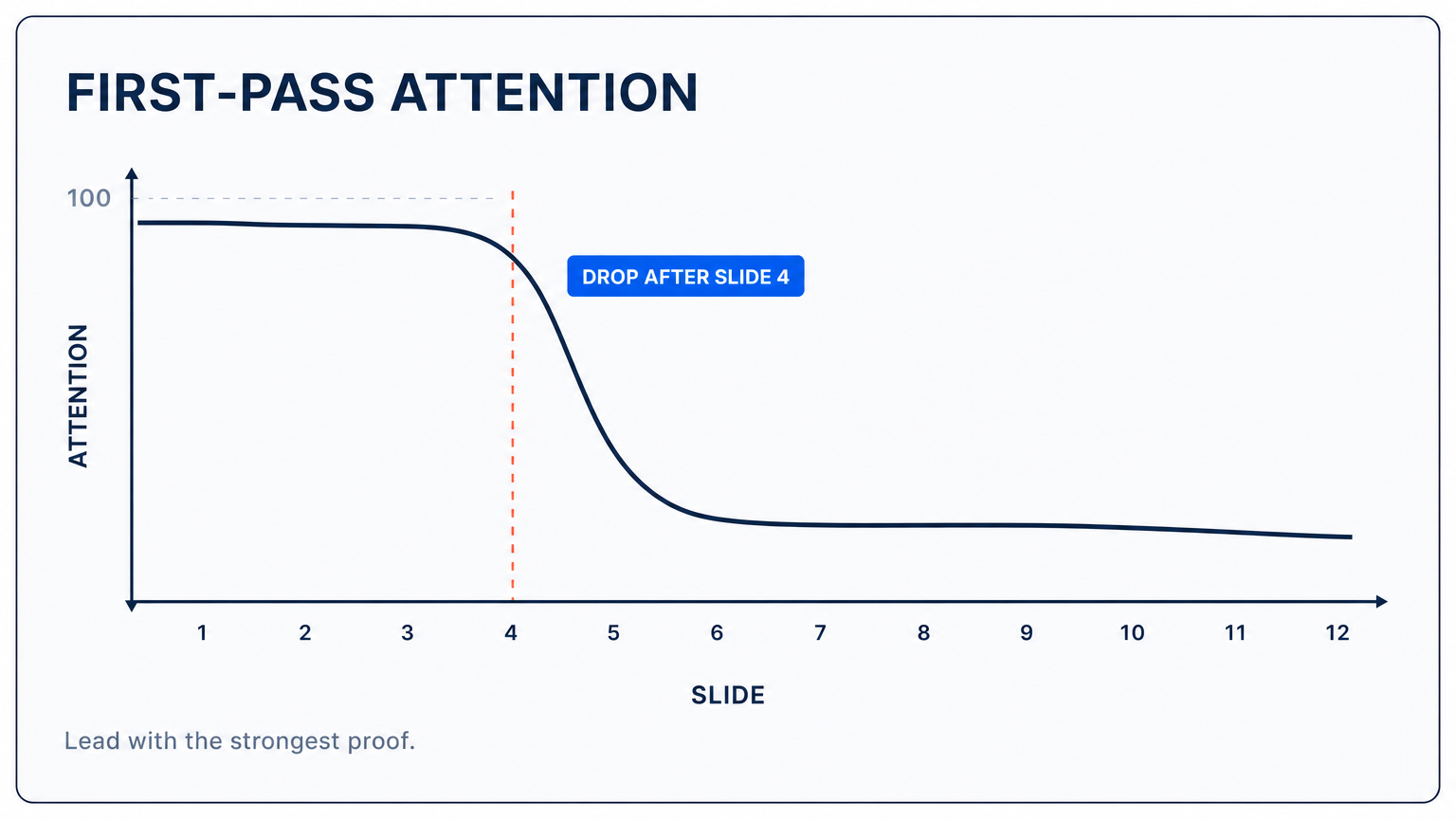
Typical first-pass skim
4
Slides that decide the meeting
1 idea
Per slide, no more
What a pitch deck is for
The job of an investor pitch deck is to make a partner pattern-match you to a bet they already understand, fast. It is not to explain the company completely. Architecture, full financials, and a 19-slide product tour belong in the appendix. You pull those when asked.
Write the send-ahead deck so it reads without your voice-over. If a slide only works when you talk, it is under-written.
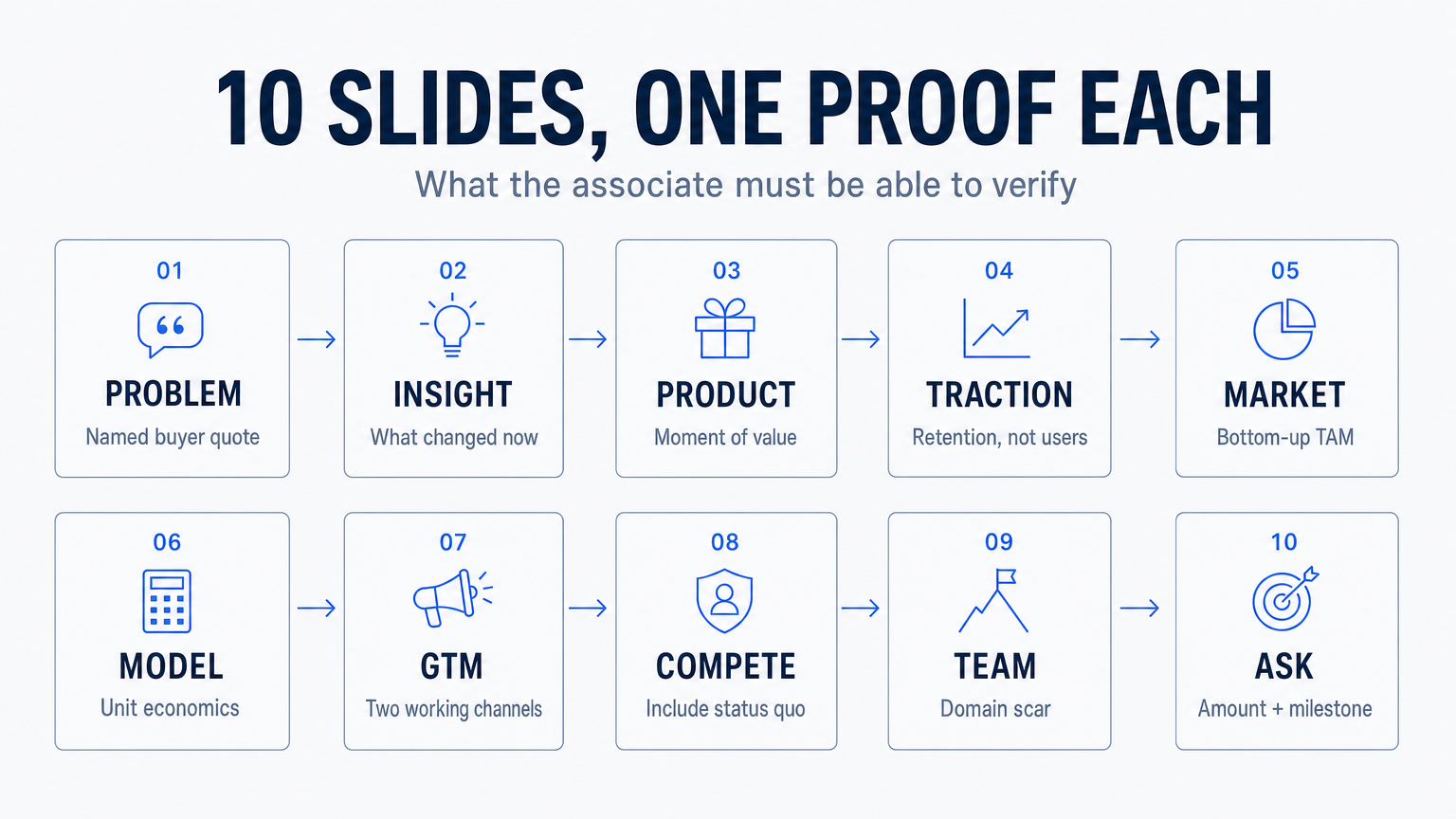
The 10 slides, and the proof each one needs
1. Title
Company name, one-line category, and the single strongest signal you have. If you have revenue growth or a named design partner, put it on the cover. “AI platform for SMBs” is a category, not a signal.
2. Problem
One buyer, one pain, one cost of inaction. Quote a customer. A TAM chart is not a problem. “Hospitals waste 11 hours a week reconciling prior auths, and the work falls on a $42/hour coordinator” is a problem.
3. Insight / why now
What changed in the world: a regulation, a cost curve, a behavior, a distribution channel. Waveup’s 2026 reviews of 1,000+ decks keep repeating the same advice: if you do not have outrageous traction or two prior exits, lead with this slide or put the insight on the cover. Feature-first openings (“we built…”) delay the reason to care.
4. Product
Two screenshots or one workflow. Show the moment value happens, not the settings page. Caption the screenshot with the job it does, not the feature name.
5. Traction
Shape beats size. A clean month-over-month curve with a note on what you did not buy (paid ads, a one-off enterprise) is stronger than a round number with no cohort. If you are pre-revenue, show paid pilots, waitlist conversion, or retention on a manual concierge. Vanity user counts get discounted.
6. Market
Bottom-up only. Start from accounts you can name, price you can defend, and a sales motion you can run. Top-down “the industry is $80B” is a tell. SAM/SOM without a path from your current ICP is decoration.
7. Business model
How money arrives, who pays, what a unit costs to serve. One sentence, then a unit-economics block. If you cannot write gross margin in one line, you are not ready to put the slide in.
8. Go-to-market
The two channels that already work, or the one channel you will work until it does. “Content + PLG + outbound + partnerships” is four untested theories. Name the first 20 accounts or the community where you already have standing.
9. Competition
A 2×2 you believe, or an honest feature table. Include the status quo (spreadsheets, agencies, doing nothing). If every competitor sits in the “slow and expensive” quadrant and you sit in “fast and cheap,” rewrite it.
10. Team and ask
Why these humans for this problem. Domain scar, not a logo row. Then amount, instrument, use of funds, and the milestone the round buys. “Raising $2.5M seed to take 40 design partners to $80k MRR in 12 months” is an ask. “Raising to scale” is not.
How to use a pitch deck template without looking like a template
Free investor pitch deck templates are useful as a checklist. They are dangerous as a script. In 2026 every associate has seen the same ten headings, and many have run the PDF through an LLM before the partner meeting. What still differentiates you:
- Lead with your unfair advantage, even if that means swapping slide order.
- Put a source under every market number.
- Show one real artifact: invoice, cohort table, signed LOI, support ticket volume.
- Cut any slide that does not answer: is the prize big, can this team win, why now?
NexTraction is a pitch deck analyzer and investor-readiness score, not a pack of Canva templates. If you need a blank 10-slide file, use YC or Sequoia’s public decks, then come back here to pressure-test the claims.
A 48-hour build order
- Hour 0–2: Write the narrative in eight sentences. No slides.
- Hour 2–6: Collect proof: metrics, quotes, logos you are allowed to use, bottom-up market math.
- Hour 6–12: One slide per sentence. One idea per slide.
- Hour 12–18: Appendix. Anything that needs more than one idea goes here.
- Hour 18–24: Cold read. Send to someone who does not love you. Time how long until they get confused.
- Hour 24–48: Fix the three questions they asked. Then run a pitch deck analyzer so the weak slides are named, not vibes.
After the draft
Analyze the deck the way an associate will.
NexTraction scores investor-readiness (IRS) across five stage-calibrated pillars and flags slides that claim without evidence. Free to start. No card.
Analyze your pitch deck →Common failure modes
- Product tour as narrative. Screenshots before the shift in the world.
- Team slide as resume dump. Connect each person to a specific risk in the plan.
- Ask with no milestone. Capital without a finish line is a request for patience.
- Appendix in the main deck. If you need 22 slides to be understood, you do not have a story yet.
FAQ
How many slides should an investor pitch deck have?
Ten to twelve for the send-ahead. Up to 15 if the extra slides are proof, not decoration. Keep the rest in the appendix.
Should I start from a pitch deck template?
Yes, as a checklist. No, as copy-paste copy. Templates do not tell you which claim is unproven.
What if I have no traction?
Show evidence of the problem and of your right to win: interviews, paid discovery, founder-market fit, a why-now that is not a trend headline. Then be honest on the ask. Pre-seed decks that fake a hockey stick get remembered for the wrong reason.
Next
Once the deck exists, treat it like a product: measure where readers stall, then fix those slides. Validate the deck, practice the room, or rehearse with a virtual VC before the meeting that matters.