


A pitch deck reviewer is not looking for prettier type. They are looking for a claim they can take to Monday’s partner meeting without getting embarrassed. That is the job of validating a pitch deck: every headline should survive the question “how do we know?”
If you still need to build the narrative, read how to create a pitch deck first. This article is the QA pass: a pitch deck analyzer mindset you can run in an afternoon, with or without software.
3 reads
Stranger, operator, rubric
5
IRS pillars to score
1 ask
Amount, use, milestone
0
Unsourced TAM figures
The three-column rubric
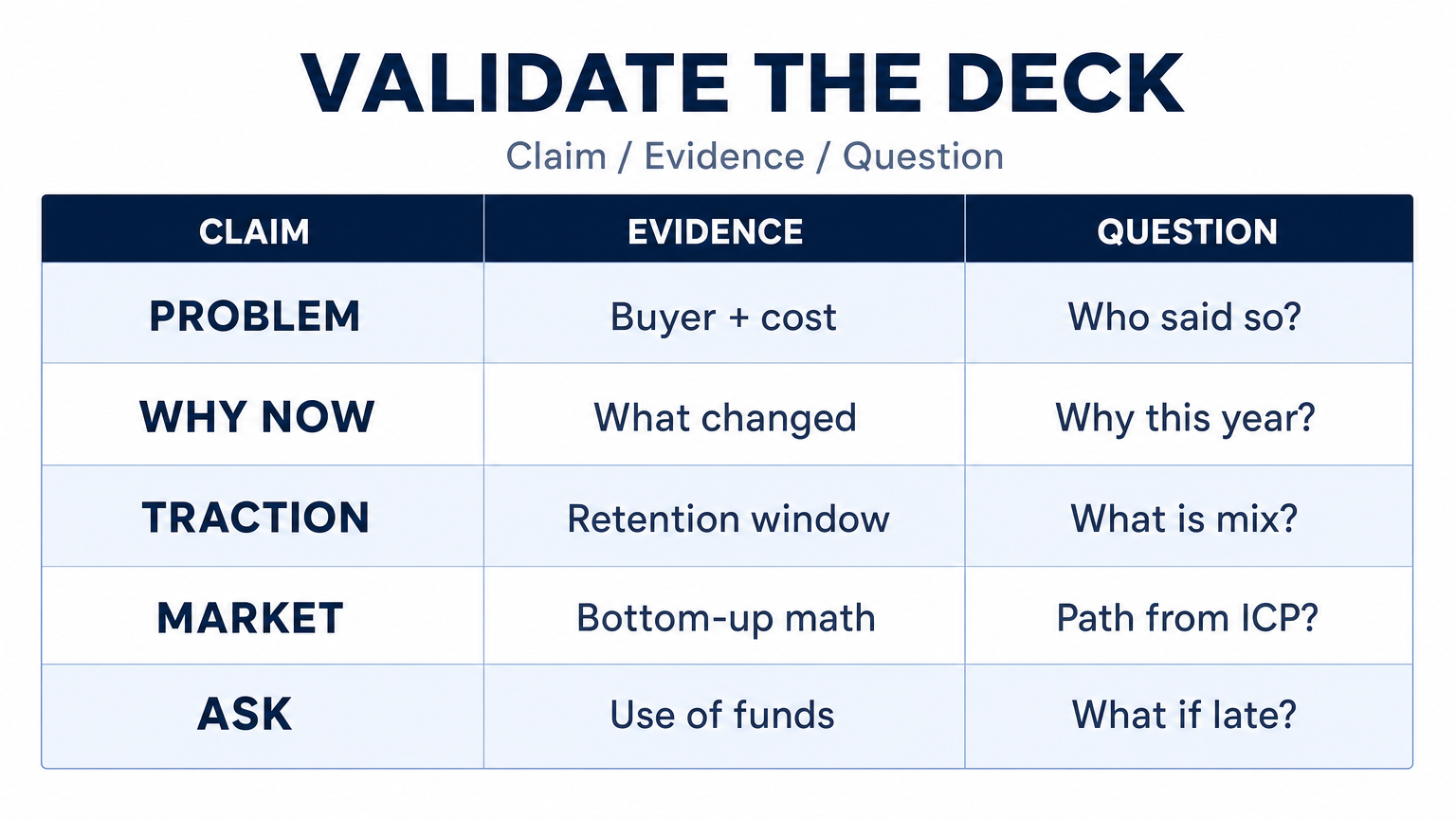
For each slide, write three cells. If a cell is empty, the slide is not ready to send.
- Claim. The sentence the slide is actually making.
- Evidence. The artifact: invoice, cohort, contract, interview notes, named design partner, instrumented metric.
- Associate question. The first hostile question a good junior will ask. If you cannot answer it in one breath, the slide is a trap.
What “good” looks like on the slides that get attacked
Problem
Good: a named buyer, a frequency, a cost. Weak: “the market is broken.” Validate with interviews or support tickets, not with a stock photo of a stressed professional.
Traction
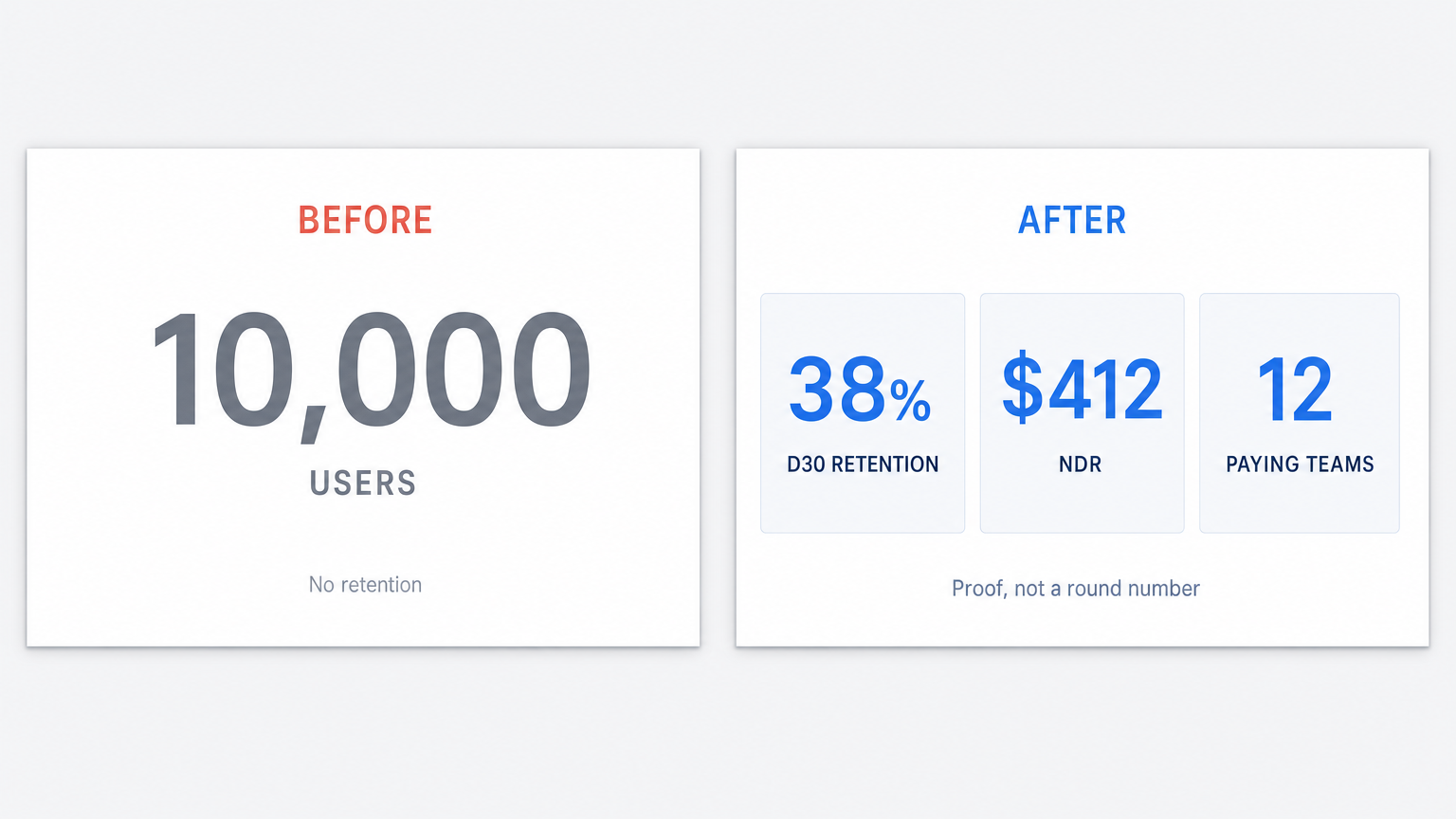
Good: revenue or retention with a time window and a note on mix (self-serve vs one whale). Weak: “10,000 users” with no D30. If the curve only works because of a launch spike, say so. Associates will find it.
Market
Good: bottom-up from accounts × price × motion. Weak: a Gartner bubble with no path from your ICP. If the only way the TAM works is “we take 1% of a huge number,” rewrite it.
Ask
Good: amount, instrument, 12-month milestone, and what breaks if the round slips 90 days. Weak: a valuation with no use of funds. The ask is the slide that turns a story into a decision.
Three reads, in order
- The stranger (15 minutes). Someone outside the company. Sit silent. Mark where they pause or invent a story you did not write. That is your narrative hole.
- The operator (45 minutes). A founder or sales lead who has missed quota. They will attack GTM and unit economics. Do not defend. Capture questions.
- The rubric (30 minutes). Score the deck on the same pillars every time so version 4 is comparable to version 1. Human notes drift. A structured pitch deck analyzer does not.
How NexTraction reviews a deck (without pretending it is a crystal ball)
Investor-readiness (IRS) is a 0–100 score across five stage-calibrated pillars: Product Readiness; Traction & Proof Points; Team & Execution Capacity; Market & Strategic Fit; Structuring, Governance & Equity Story. It measures whether the story is evidenced for your stage, not whether a fund will write a check. We tuned what counts as evidence on 237 internal screenings. That is a calibration set, not a forecast of your raise.
Use the score to find slides that are louder than the proof. Then fix those slides. Pair it with pitch practice so the verbal version matches the PDF.
Pitch deck analyzer
Get the holes named before the partner meeting.
Upload the deck, get IRS plus slide-level notes. Free to start.
Analyze your pitch deck →Red flags a pitch deck reviewer will not forgive in 2026
- AI-polished prose with no operating numbers.
- Competitor 2×2 where you occupy the only attractive quadrant.
- Team slide that hides a missing function you are raising to hire.
- Financials that start in month 18 at a scale you have never sold.
- Customer logos you do not have permission to use.
FAQ
Is a pitch deck analyzer enough?
No. Software is the consistent third read. You still need a human who will be rude, and you still need the underlying business to be real. See idea validation if the deck is covering for a weak company.
Should I send the same deck cold and in the room?
Same spine, different density. The cold deck must stand alone. The live deck can drop text and keep the proof visual. Do not surprise the room with a new business model.
Next
When the PDF holds up, practice the Q&A. The deck gets you in the room. The answers keep you there. Rehearse the meeting or read how to pitch to VCs.