


You've built something amazing. You've validated the market. You've got early traction. Now comes the moment that will determine your startup's future: pitching to venture capitalists.
The average VC sees 1,000+ pitch decks per year and invests in just 1-2% of them. Your pitch needs to be exceptional to break through the noise. This comprehensive guide distills insights from analyzing 500+ successful pitch decks and interviewing dozens of VCs to give you the exact framework for a winning pitch.
1,000+
Decks per VC / year
1–2%
Get funded
3:44
Median first read
10–15
Optimal slide count
What VCs Actually Look for in a Pitch
Before diving into pitch mechanics, understand what VCs are really evaluating. It's not just your product—it's whether you and your startup fit their investment thesis.
The Three Core Questions Every VC Asks
- Is this a big enough opportunity? Can this become a $100M+ revenue company? Is the market large and growing?
- Can this team execute? Do the founders have the skills, experience, and determination to win? Are there gaps in the team?
- Why now? What's changed in the market, technology, or regulation that makes this the right time for this solution?
Every element of your pitch should answer one or more of these questions. If a slide doesn't, cut it.
What Makes VCs Say Yes
Based on our analysis of 500+ funded startups, these factors correlate most strongly with investment decisions:
- Clear, specific problem: VCs can immediately understand the pain point
- Quantified market opportunity: TAM/SAM/SOM with credible sources
- Demonstrable traction: Revenue, users, or strong leading indicators
- Unfair advantage: Something competitors can't easily replicate
- Team-market fit: Why is this team uniquely positioned to win?
- Clear path to $100M+: Unit economics and growth strategy make sense
The Perfect Pitch Deck Structure
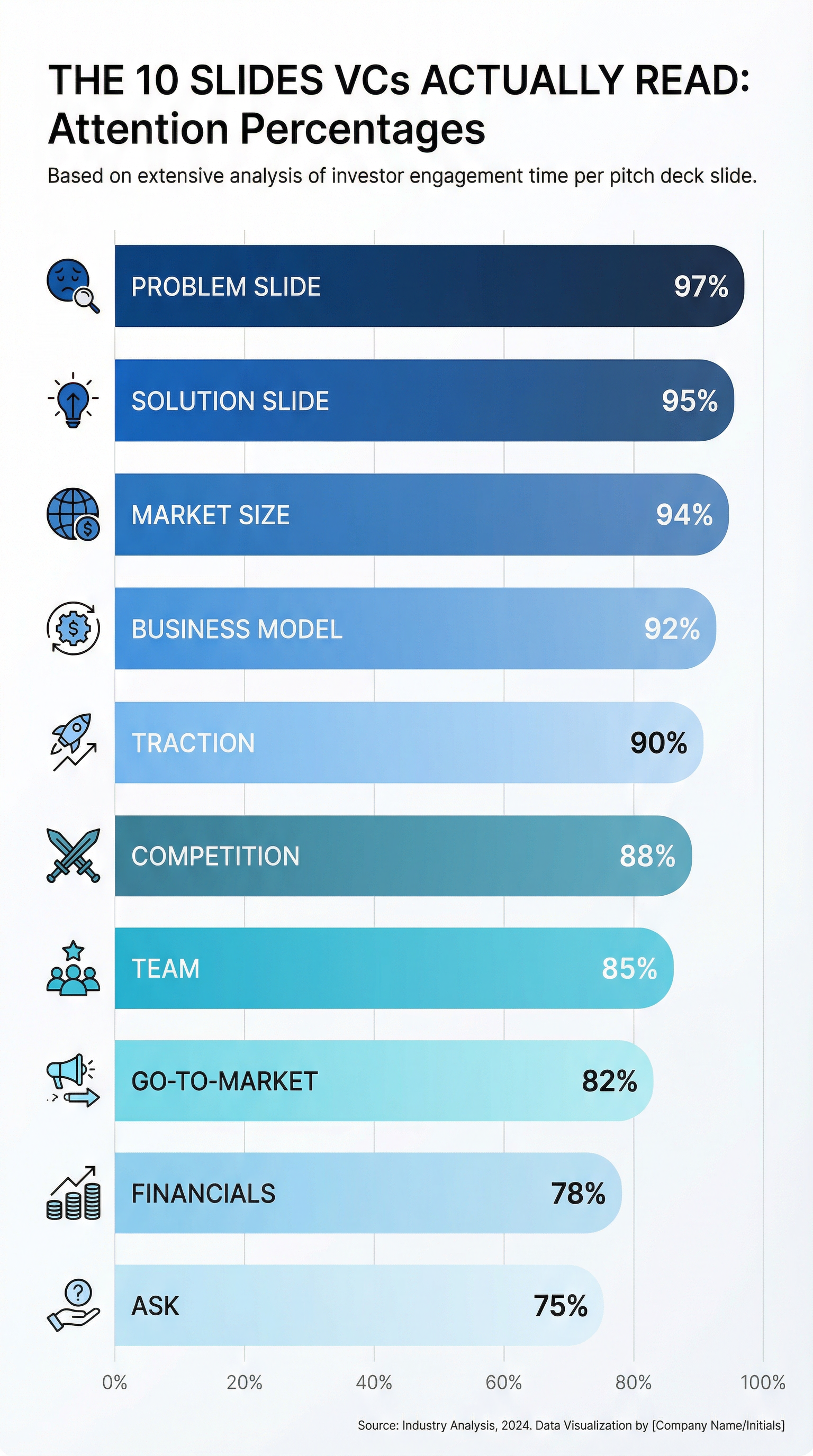
Your pitch deck should be 10-15 slides and tell a compelling story. Here's the proven structure:
Slide 1: Company Introduction
What to include:
- Company name and logo
- One-sentence tagline describing what you do
- Your name and title
- Contact information
Pro tip: Your tagline should be clear, not clever. "AI-powered market validation for startups" beats "Turning ideas into traction."
Slide 2: The Problem
What to include:
- Specific, relatable problem statement
- Who experiences this problem
- Current solutions and why they fail
- Cost/impact of the problem (quantified)
Example: "42% of startups fail due to no market need. Founders spend $50,000+ building products nobody wants because they skip validation. Current options: expensive consultants ($5,000+) or DIY research (100+ hours)."
Pro tip: Use a customer story or quote to make the problem tangible. "Sarah spent 8 months building her app before discovering her target market didn't exist."
Slide 3: The Solution
What to include:
- Your product/service in one sentence
- How it solves the problem
- Key features or capabilities
- Why it's 10x better than alternatives
Pro tip: Show, don't tell. Include a product screenshot, demo video, or before/after comparison. Visual evidence is more convincing than text.
Slide 4: Market Size
What to include:
- TAM (Total Addressable Market): The entire market opportunity
- SAM (Serviceable Addressable Market): The portion you can realistically serve
- SOM (Serviceable Obtainable Market): What you can capture in 3-5 years
- Market growth rate and trends
Pro tip: Use bottom-up calculations, not top-down. "10 million small businesses × $500 average contract value = $5B SAM" is more credible than "We're targeting 1% of the $500B software market."
Slide 5: Product/Demo
What to include:
- Product screenshots or demo video
- Key user flows or features
- What makes it unique
- Technology or IP advantages
Pro tip: If you have a working product, do a live demo. It's riskier but far more impressive than screenshots. Practice until you can do it flawlessly in 2 minutes.
Slide 6: Business Model
What to include:
- How you make money (subscription, transaction fee, licensing, etc.)
- Pricing tiers and what's included
- Unit economics: CAC, LTV, gross margin
- Path to profitability
Pro tip: Show that you understand your economics. "CAC of $150, LTV of $900, 6-month payback period" demonstrates financial sophistication.
Slide 7: Traction
What to include:
- Revenue (if any)
- User/customer count and growth rate
- Key partnerships or customers
- Product milestones achieved
Pro tip: Show growth trajectory, not just current numbers. A graph showing 20% month-over-month growth is more impressive than a single revenue figure. If you don't have revenue yet, show leading indicators: waitlist signups, pilot customers, LOIs.
Slide 8: Competition
What to include:
- Direct and indirect competitors
- Competitive positioning (2x2 matrix or feature comparison)
- Your unique advantages
- Barriers to entry you're building
Pro tip: Never say "we have no competitors." It signals you don't understand the market. Instead, acknowledge competitors and explain why you'll win. "Competitor A is expensive ($5,000+), Competitor B is slow (weeks for results). We're fast (minutes) and affordable ($29/month)."
Slide 9: Team
What to include:
- Founders with photos, names, and titles
- Relevant experience and achievements
- Why this team is uniquely qualified
- Key advisors or investors
Pro tip: Focus on relevant experience, not just impressive credentials. "Sarah led product at Stripe" is relevant for a fintech startup. "John has a PhD in physics" is less relevant unless you're a deep-tech company.
Slide 10: Go-to-Market Strategy
What to include:
- Customer acquisition channels
- Customer acquisition cost (CAC) and strategy
- Sales process and timeline
- Partnership or distribution strategies
Pro tip: Show that you've tested channels. "We've acquired 500 customers via content marketing at $50 CAC. We're now scaling this channel and testing paid ads."
Slide 11: Financials
What to include:
- 3-5 year revenue projections
- Key assumptions behind projections
- Path to profitability
- Use of funds from this round
Pro tip: Be realistic, not aspirational. VCs discount aggressive projections. Show 3 scenarios: conservative, base case, and optimistic. Explain your assumptions clearly.
Slide 12: The Ask
What to include:
- How much you're raising
- What you'll accomplish with the funds
- Key milestones for next round
- Timeline and current status (how much is committed)
Pro tip: Be specific about use of funds. "We're raising $2M: $1M for engineering team (5 hires), $500K for marketing, $500K for 18-month runway" is better than "We're raising $2M for growth."
Storytelling: The Secret Weapon
Data and slides matter, but storytelling is what makes your pitch memorable. VCs see dozens of pitches per week—the ones they remember tell a compelling story.
The Narrative Arc
Structure your pitch like a story:
- Setup: Introduce the problem and why it matters
- Conflict: Explain why existing solutions fail
- Resolution: Present your solution as the answer
- Proof: Show traction and validation
- Vision: Paint the picture of the future you're building
Storytelling Techniques That Work
- Start with a customer story: "Meet Sarah, a first-time founder who spent 8 months building an app before discovering her market didn't exist..."
- Use the "before/after" framework: Show the world before your solution and after
- Create urgency with "why now": What's changed that makes this the right time?
- Use analogies: "We're the Stripe for X" or "Think Airbnb meets Y" helps VCs quickly understand your model
- End with vision: "In 5 years, every founder will validate their idea before building, just like they incorporate their company. We're building that future."
Delivering the Pitch: Presentation Tips
Your deck is just the visual aid. How you present matters even more.
Preparation
- Practice 20+ times: Rehearse until you can deliver without notes
- Time yourself: Aim for 10-12 minutes, leaving time for questions
- Anticipate questions: Prepare answers for the 20 most likely questions
- Know your numbers cold: CAC, LTV, churn, growth rate—memorize them
During the Pitch
- Start strong: Hook them in the first 30 seconds with a compelling problem or stat
- Make eye contact: Connect with each person in the room
- Show passion: Enthusiasm is contagious, but don't be overly salesy
- Pause for questions: Don't rush through. Engagement is a good sign
- Read the room: If they're leaning in, slow down. If they're checking phones, speed up or ask a question
Handling Questions
- Listen fully: Don't interrupt or start answering before they finish
- Clarify if needed: "Just to make sure I understand, you're asking about..."
- Be honest: "I don't know, but I'll find out" beats making up an answer
- Bridge to strengths: "That's a great question. What's important to note is..."
- Don't get defensive: Tough questions are a sign of interest, not rejection
Common Pitch Mistakes to Avoid
1. Too Much Information
Don't cram 50 slides into 15 minutes. Less is more. Every slide should serve a purpose. If it doesn't advance your narrative, cut it.
2. Ignoring the Competition
Saying "we have no competitors" signals naivety. Every startup has competition, even if it's the status quo or manual processes.
3. Unrealistic Projections
"We'll capture 1% of a $500B market" is a red flag. Show bottom-up projections based on realistic assumptions.
4. Focusing on Features, Not Benefits
VCs don't care about your tech stack. They care about the problem you solve and the value you create.
5. Weak Team Slide
If your team lacks relevant experience, acknowledge it and explain how you'll fill gaps. Better yet, recruit advisors or team members who strengthen your credibility.
6. No Clear Ask
Be specific about how much you're raising, what you'll do with it, and what milestones you'll hit. Vague asks signal lack of planning.
Practice before the real meeting
Run your pitch live against simulated investor personas.
NexTraction's Virtual VC simulates the questions a skeptical generalist, a sector specialist, and a B2B-focused early-stage partner would ask — with live coaching feedback as you speak. Founders who run 8+ simulated pitches stop getting surprised by real-investor questions.
Try a Virtual VC session →After the Pitch: Follow-Up
The pitch meeting is just the beginning. What you do next matters.
Immediate Follow-Up (Within 24 Hours)
- Send a thank-you email
- Attach your deck and any requested materials
- Answer any questions that came up
- Propose next steps
Ongoing Communication
- Send monthly updates even if they haven't committed
- Share traction milestones and wins
- Be responsive to requests for information
- Don't ghost if you get another offer—give them a chance to participate
Tools to Improve Your Pitch
- NexTraction Pitch Deck Analyzer: Get AI-powered feedback on your deck before pitching to VCs
- Beautiful.ai or Pitch: Design tools for creating professional decks
- DocSend: Track who's viewing your deck and which slides they spend time on
- Loom: Record video pitches for async review
Conclusion: Practice Makes Perfect
Pitching VCs is a skill that improves with practice. Your first pitch will be rough. Your tenth will be better. Your fiftieth will be polished.
The key is to start early, get feedback, and iterate. Use tools like NexTraction's Virtual VC simulation to practice answering tough questions before you face real investors.
Remember: VCs invest in founders, not just ideas. Your pitch is your chance to show that you're the person who can turn this opportunity into a $100M+ company. Make it count.
Ready to perfect your pitch? Try NexTraction's AI-powered pitch deck analysis and get specific feedback on how to improve your deck before your next VC meeting.
FAQ
How long should a live VC pitch be?
Plan for 15 to 20 minutes of talking and 20 to 30 minutes of questions. The deck is a spine, not a script you read.
Should I send the deck before the meeting?
For cold outreach, yes. For a warm intro, ask the person who introduced you. Most partners want to skim first.