


Founders deserve to know how their idea is being scored. So do investors. This article is the public version of how NexTraction's Market Validation Index (MVI) and Investor Readiness Score (IRS) work in the product — the same labels you see when you validate a business idea or run a pitch deck analyzer.

237
Screenings used to tune evidence
6
MVI pillars
5
IRS pillars
0–100
Each score range
What the MVI is — and isn't
The MVI is a 0–100 evidence-quality score. It asks whether you have enough proof to justify the next unit of time, money, or hiring. It is not a prediction of success, and it is not a fundraising forecast.
If a model can't be argued with, it's a black box. If a black box scores founders, founders won't trust it. So we open the box.
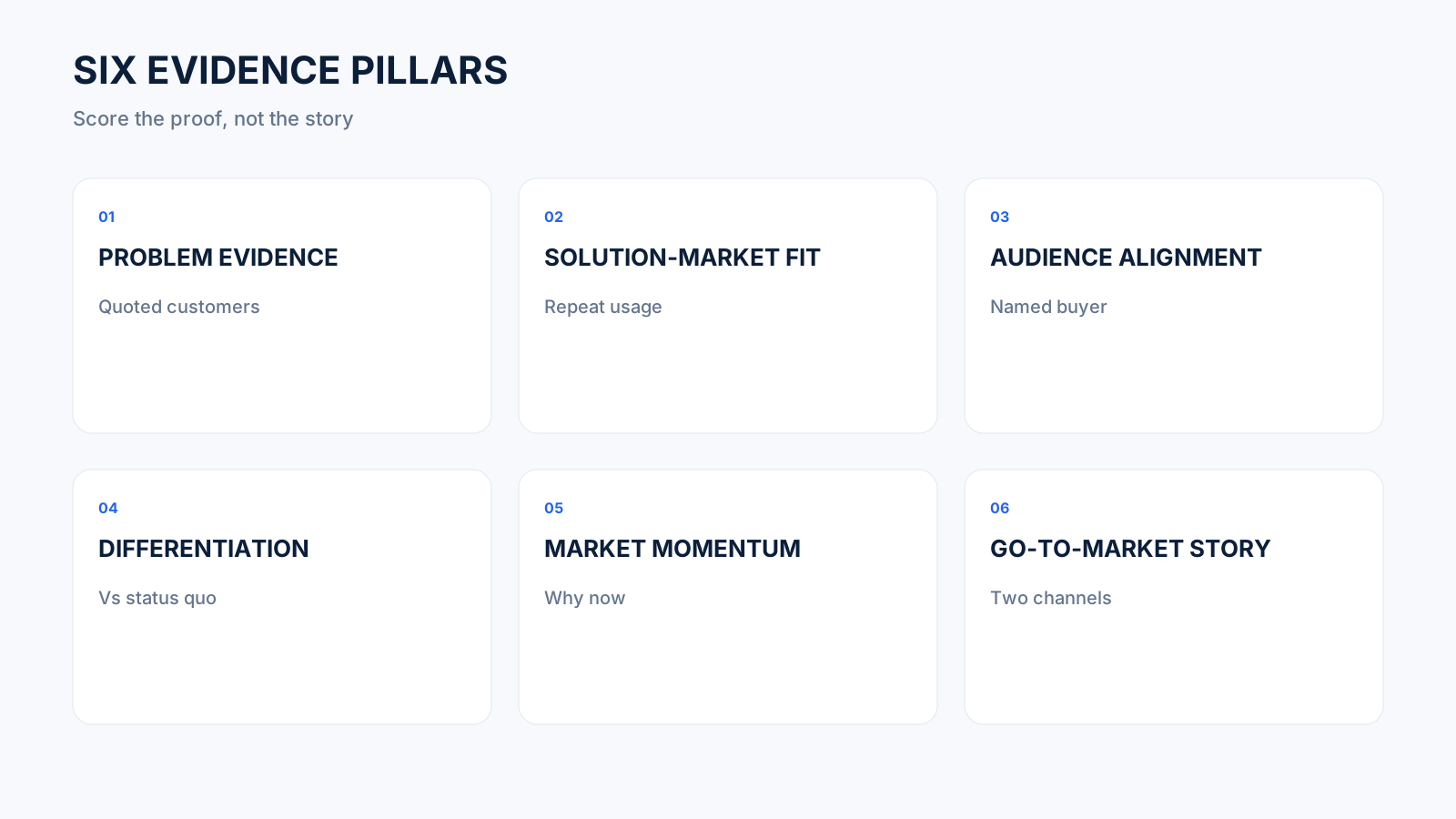
The six MVI pillars (what the product scores)
These names match the in-app scorecard. Each pillar is scored 0–100 with cited evidence. The overall MVI is a 0–100 composite of the six.
| Pillar | What we score |
|---|---|
| Problem Evidence | Is the pain real, frequent, and costly enough that people would pay to make it go away? |
| Solution-Market Fit | Does the solution map tightly to that job, or is it a pile of shallow features? |
| Audience Alignment | Who exactly has the problem, and does the story speak to that person? |
| Differentiation | Why this, not the workaround or the incumbent? |
| Market Momentum | Is the market moving toward this job, or away from it? |
| Go-to-Market Story | How do you reach buyers, and does that channel story hold up? |
1 · Problem Evidence
How well is the problem defined and supported? We look for frequency, urgency, and whether people volunteer willingness to pay before being prompted.
2 · Solution-Market Fit
How tightly does the solution map to the problem? Sharp wedges (one job done extremely well) score higher than broad surface area.
3 · Audience Alignment
Who has the problem, in what context, and does the pitch talk to that person? Vague “everyone” audiences score poorly.
4 · Differentiation
Why you, not the spreadsheet, the agency, or the incumbent. Feature lists without a wedge do not count as an edge.
5 · Market Momentum
Is adoption already happening around this job, or are you asking the market to invent a habit?
6 · Go-to-Market Story
Distribution, not feature edge. A believable path to the first buyers scores higher than a TAM slide with no channel.
IRS: five stage-calibrated pillars
IRS is a separate 0–100 score. It asks whether the project is ready to be scrutinized as an investment, not whether the idea is real. Pillar weights adapt to stage (idea through growth). The five pillars in the product are:
| Pillar | What we score |
|---|---|
| Product Readiness | Maturity of the product relative to stage |
| Traction & Proof Points | Customers, revenue, retention, and the quality of those proofs |
| Team & Execution Capacity | Whether this team can ship the next stage |
| Market & Strategic Fit | Timing, category, and why this market now |
| Structuring, Governance & Equity Story | The round, the model, and whether the story is investable |
How the 237 screenings are used
An internal set of 237 historical screenings is used to tune what counts as sufficient evidence on each pillar. That is not a claim that a given score predicts who raises, who pivots, or who shuts down. Plenty of high-MVI startups fail. Plenty of low-MVI startups succeed.
Score interpretation
80–100 · Strong evidence
Most pillars are well supported. The next stage of spend is easier to justify.
65–79 · Solid
A usable foundation, with one or two pillars that still need proof.
50–64 · Mixed
Mixed signal. Investigate the weak pillars before adding more capital.
Below 50 · Thin evidence
Not enough proof yet. Close the gaps, or change the idea, before you scale spend.
Validate a business idea with the same scorecard
See your MVI and IRS across the product pillars in under an hour.
The analysis uses the six MVI pillars and five IRS pillars described here, with cited evidence on each, and a memo of the gaps to close.
Run the idea validation tool →What the MVI explicitly does NOT do
It does not predict success. It scores evidence quality. Plenty of high-MVI startups fail; plenty of low-MVI startups succeed.
It does not replace founder judgment. If the model says 73 and your gut says no, listen to your gut and re-score.
It does not work for every business model. Deep-tech, biotech, and hard-science ventures need a different scorecard.
Why we publish this
Two reasons. First, founders should be able to argue with the model — that's how it gets better. Second, opaque scoring is a bad look for an industry that already has a trust problem with founders. We'd rather be wrong in public than mysteriously right behind a paywall.
Conclusion
The MVI is one tool among many. Treat it as a checklist that forces honesty, not as a verdict. Validate a business idea with it, or run a pitch deck analyzer, and tell us where the model gets it wrong — that's how we improve.
FAQ
Is the MVI a prediction of whether I will raise?
No. It scores evidence quality on six pillars. High scores still fail. Low scores still succeed. Treat empty pillars as this week's research agenda.
How is MVI different from IRS?
MVI is idea and evidence quality. IRS is how the same project holds up under investor scrutiny, with five stage-calibrated pillars.