

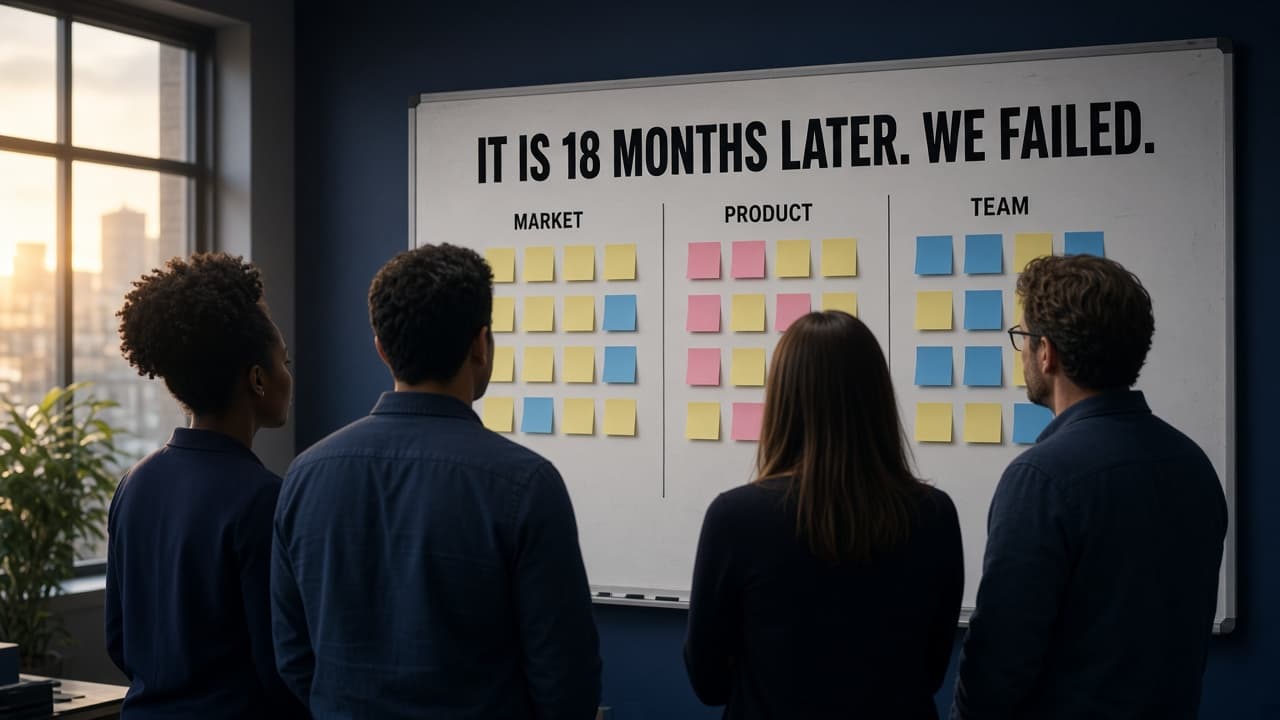
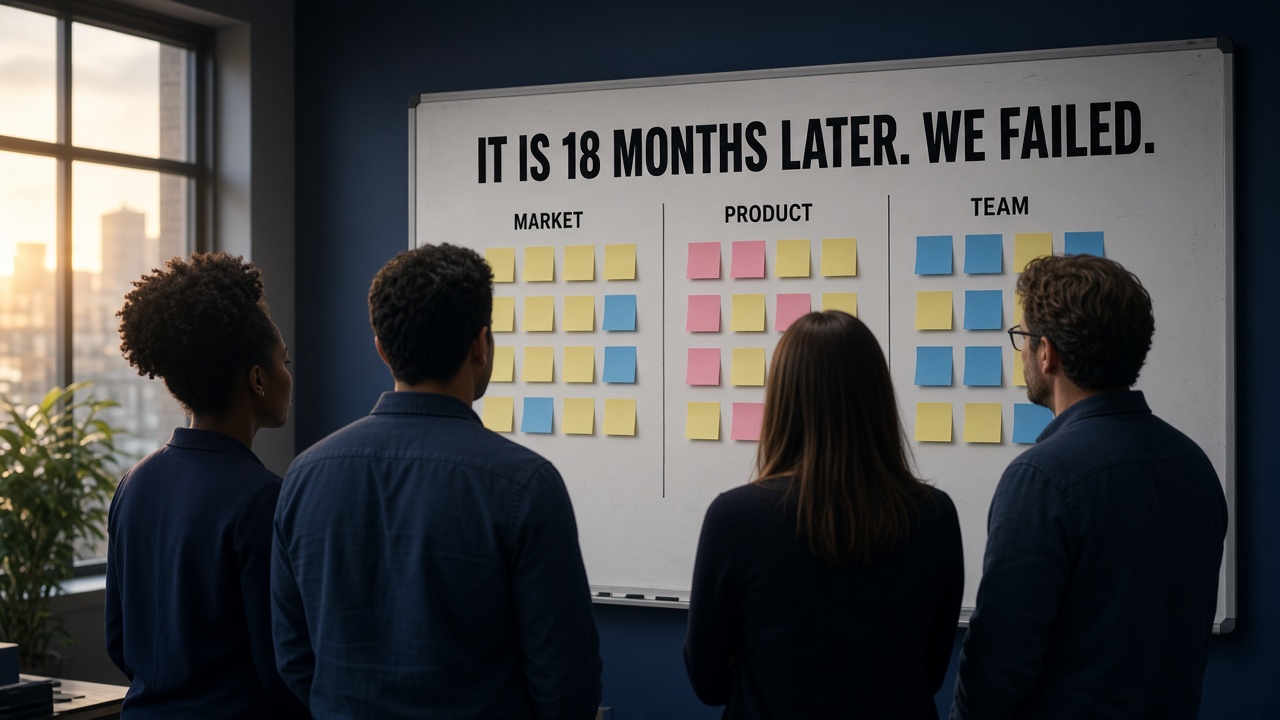
It's twelve months from today. Your startup has shut down. You're standing in front of your investors writing the post-mortem email. What would it say? That single question is the heart of one of the most useful exercises a founding team can run — and almost nobody does it. This is the pre-mortem, and you can run it in 90 minutes with the right structure.
90 min
Total exercise time
+30%
Risk identification
4 steps
In the playbook
Q1 / Q3
When to re-run
Why pre-mortems work
Gary Klein's research found that pre-mortems increase a team's ability to identify reasons for future failure by 30% compared with standard planning. The mechanism is simple: humans are bad at imagining failure prospectively but excellent at explaining it retrospectively. The pre-mortem hijacks the retrospective brain to do prospective work.
"Prospective hindsight — imagining that an event has already occurred — increases the ability to correctly identify reasons for future outcomes by 30 percent." — Gary Klein, HBR
The 4-step playbook
Step 1 · Set the scene (10 min)
Get the whole founding team in one room. State the prompt clearly: "It's [today's date] + 12 months. Our startup is dead. We are writing the email to investors explaining why." Be specific about the date — vague timeframes produce vague answers.
Step 2 · Silent generation (20 min)
Each person writes — alone, in silence — every plausible reason the startup failed. No filtering. No diplomacy. The point is volume and honesty. Group brainstorming kills pre-mortems because the loudest voice anchors the room.
Step 3 · Cluster & rank (30 min)
Read all the failure modes out loud. Group them into 4–6 clusters (e.g., "we built the wrong thing," "we couldn't get distribution," "we ran out of cash too fast," "key person left"). Then vote: each person picks the two most likely clusters.
Step 4 · Convert risks into experiments (30 min)
For each top-voted cluster, design one experiment the team will run in the next 30 days to disprove or contain the risk. The output of the pre-mortem is not a list of fears — it's a list of bets the team is making to test those fears.
The 5 failure clusters that show up most often
1 · Wrong product
"We built what we thought they wanted. They wanted something adjacent."
2 · No distribution
"We had a great product. Nobody knew. CAC ate the runway."
3 · Co-founder split
"We disagreed on direction. We didn't surface it. It exploded."
4 · Cash burn surprise
"Our 18-month runway was 11. We didn't see the AWS bill curve."
5 · Regulatory ambush
"A new rule made our core feature illegal in our biggest market."
6 · Founder burnout
"The founder kept the secret too long. It wasn't sustainable."
What changes after a good pre-mortem
- The roadmap re-orders. Suddenly the "distribution experiment" the team had been deferring jumps to the top of next sprint.
- One conversation gets had. Co-founder disagreement, runway anxiety, key-person risk — pre-mortems force the conversation that keeps getting deferred.
- One thing gets killed. A planned feature, a hiring plan, an entire market — pre-mortems are excellent at exposing things that won't work but feel too sunk-cost to cut.
Turn the pre-mortem into a memo
Convert failure modes into a structured plan, not a sticky-note pile.
NexTraction's memo synthesis takes your pre-mortem inputs — risks, assumptions, the experiments you'll run — and ships them as a board-ready document. The pre-mortem becomes a memo the whole team is operating from, not a workshop nobody remembers next week.
Generate a pre-mortem memo →FAQ
When should I run a pre-mortem?
At the start of every quarter. Twice a year minimum. Always before a major commitment (a big hire, a market expansion, a fundraise).
Should I include investors?
No — at least not the first time. Investors want optimism. The pre-mortem requires permission to be pessimistic. Keep it founding-team-only for the first round.
What if the team can't think of failure modes?
That's a signal. Either the team is too aligned (no diverse thinking) or too scared (psychologically unsafe). Both are worse than any specific risk.
Conclusion
The pre-mortem is the cheapest, fastest exercise you'll find for catching the thing that's actually going to kill your startup. Spend 90 minutes on it now. Spend 90 minutes on it again next quarter. Pressure-test your top failure modes against structured customer panels to convert risks into experiments.