


Founders today have three real options for getting venture-grade research and pitch prep done: hire a consultant, stitch together a stack of point tools, or use an integrated platform like NexTraction. Each makes sense in different contexts. This honest comparison lays out the tradeoffs so you can pick the one that fits your stage — even if that means choosing a competitor.
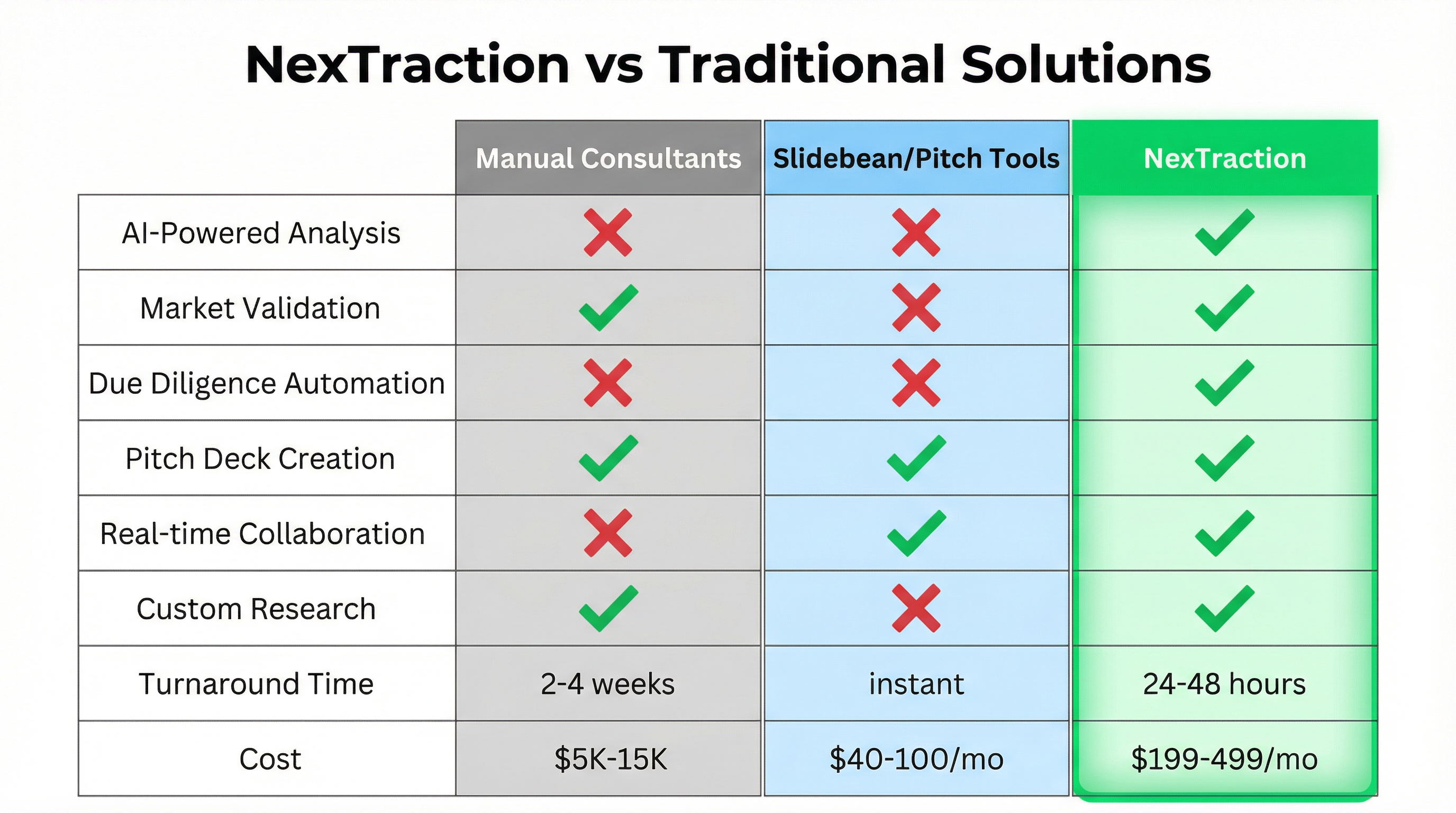
The three categories at a glance
| Option | Cost | Time-to-output | Best for |
|---|---|---|---|
| Manual consultants | $5K–15K / project | 2–6 weeks | Late-stage one-off deep dives |
| Point tools (DIY stack) | $40–100 / month / tool | Hours–days | Pre-seed founders learning the space |
| Integrated platform (NexTraction) | $199–499 / month | Minutes–hours | Seed → Series A founders & small VC funds |
Option 1 · Manual consultants
The traditional route. Hire a market research firm, a pitch coach, and maybe a fractional CFO. You get bespoke depth and senior judgment. The math hurts: $5K–15K per engagement, 2–6 week turnarounds, and you start over each time you need a new question answered.
Strengths
- Senior human judgment
- Bespoke to your context
- Hand-holding through complexity
Weaknesses
- $5K–15K minimum spend
- Weeks of turnaround
- No reusable framework
Option 2 · Point tools (DIY stack)
The frugal-founder approach. Cobble together SurveyMonkey, Typeform, Pitch.com, Calendly, Notion, ChatGPT, and a Loom subscription. Each tool is cheap. Together they cost ~$300/mo. The hidden cost is integration: you become your own analyst, your own designer, and your own coach.
Strengths
- Cheap per tool
- Maximum flexibility
- You own the learning
Weaknesses
- You're the integration layer
- No structured methodology
- Easy to get false signal
Option 3 · NexTraction
The integrated middle path. Six modules sharing one evidence layer: project analysis, persona panels, pitch practice (Virtual VC), deck builder, investor workspace, and memo synthesis. You get 90% of consultant-grade methodology at ~5% of the cost, in days instead of weeks.
Strengths
- Single workspace, shared evidence
- Minutes-to-output, not weeks
- Methodology baked in
- Multi-language & multi-stage
Weaknesses
- Less bespoke than a consultant
- Pricier than a single point tool
- Best for pre-seed → Series A
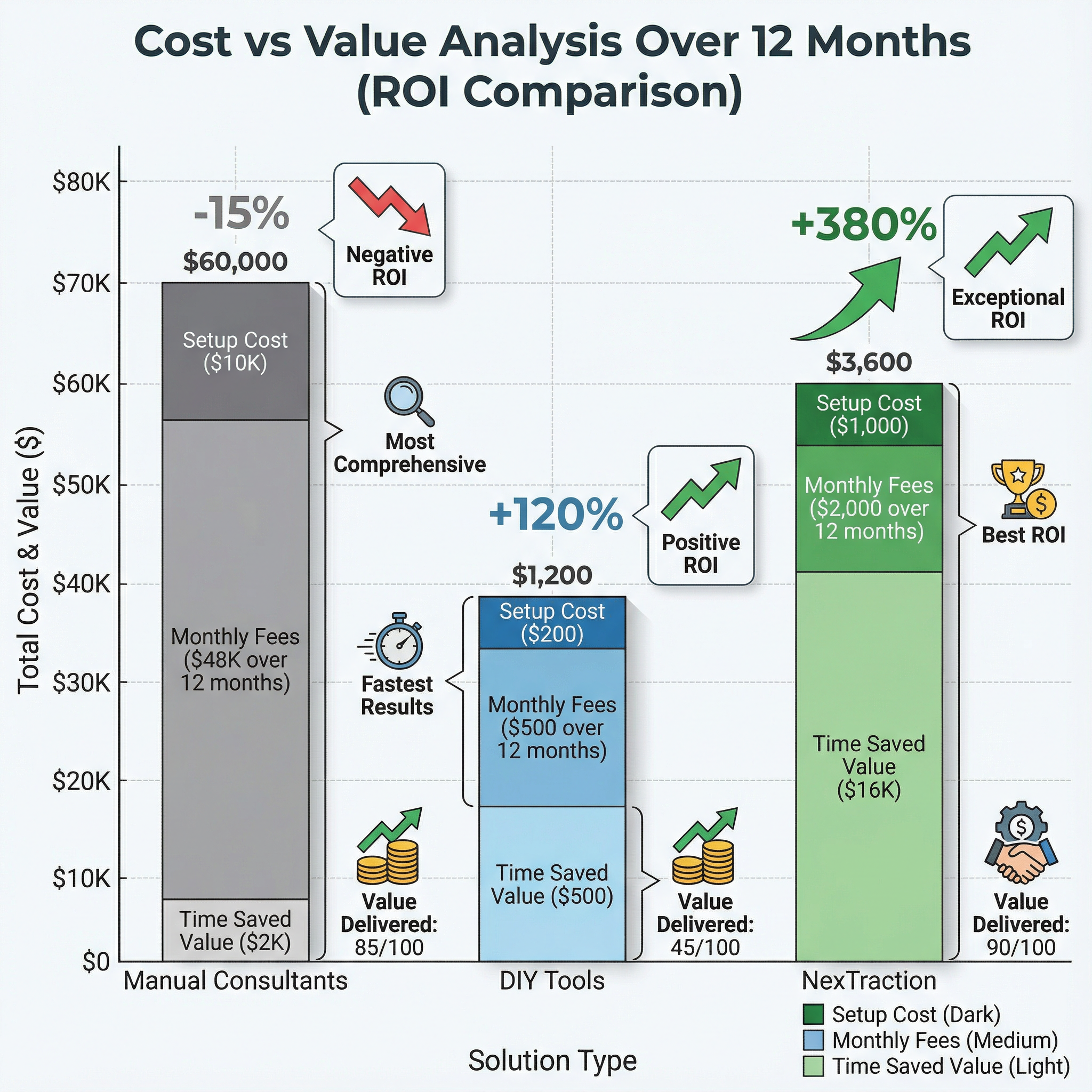
How to choose — by stage
Pre-seed
Start with point tools while you learn the territory. Switch to NexTraction when you're running structured validation more than once a week.
Seed → Series A
Sweet spot for an integrated platform. You're running validation, pitching, and deck iteration weekly. NexTraction wins on time-saved alone.
Series B+
Use NexTraction for ongoing research; bring in specialist consultants for one-off deep dives like a board memo or an M&A defense.
"NexTraction isn't a replacement for senior judgment — it's a forcing function for evidence. It compresses the work that matters and lets you spend the saved time on the things that actually need a human brain."
The honest verdict
- Choose consultants when you have a one-off need, a budget over $10K, and time to wait.
- Choose point tools when you're brand new and need to learn what good research looks like.
- Choose NexTraction when you're doing structured research weekly and want one place to do it.
See it for yourself
Run a free panel session and judge the methodology directly.
Three full sessions, no credit card required. The best comparison isn't a feature matrix — it's pointing the platform at your real idea and seeing what comes back.
FAQ
Is NexTraction better than a consultant?
For 80% of recurring founder workflows, yes — at roughly 5% of the cost. For the remaining 20% (one-off legal due diligence, M&A defense, board-prep deep dives), a senior consultant still wins. They're not in the same category.
How much does NexTraction cost vs a DIY tool stack?
A typical DIY stack runs $250–400/mo when you add up all the SaaS subscriptions plus your time as the integration layer. NexTraction starts at $199/mo and replaces 5+ tools.
What's the lock-in?
None. Memos export as PDF, transcripts as JSON, decks as PPTX. Cancel anytime, leave with all your data. We bet on the methodology, not the data lock-in.
Conclusion
The right tool depends on your stage and how often you're doing the work. If you're validating, pitching, and iterating weekly, an integrated platform pays back in time alone. Run a free session and judge the output against your own DIY workflow.


