


Market validation isn't a single experiment — it's a sequence. Done right, four focused weeks can replace six months of guesswork. This guide gives you the exact week-by-week roadmap, the research methods that actually surface signal, and the metrics that let you stop and ship versus pivot and rebuild.
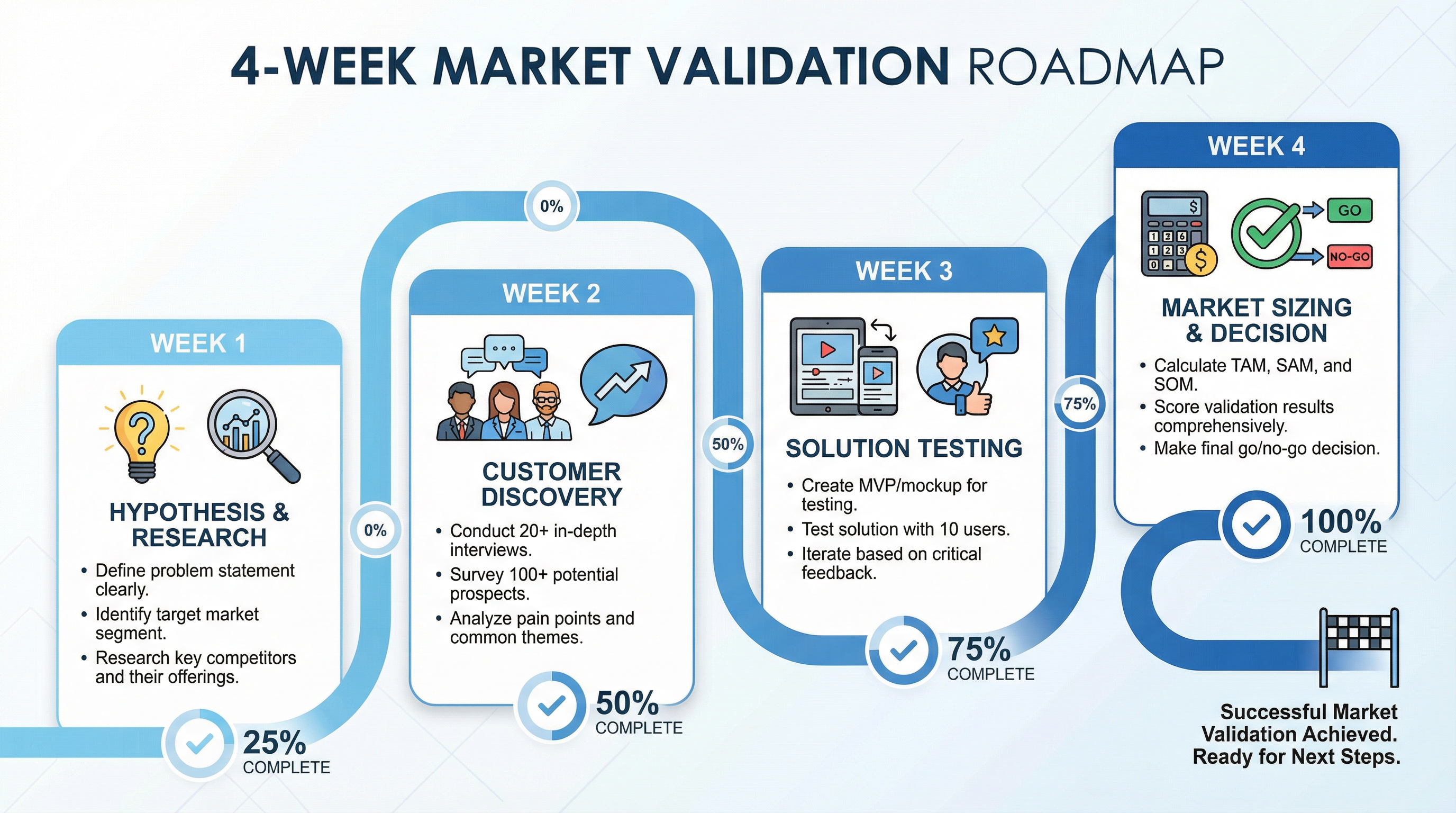
4 wks
End-to-end
20–30
Customer interviews
42%
Startups that fail on no demand
$0
Code needed to validate
The 4-week roadmap
| Week | Focus | Output |
|---|---|---|
| 1 | Hypothesis & secondary research | Tight problem statement + 5 testable assumptions |
| 2 | Customer discovery interviews | 20+ interview transcripts + insight matrix |
| 3 | Solution testing (landing page, prototype, fake-door) | Conversion data + willingness-to-pay signal |
| 4 | Market sizing & go/no-go memo | Bottom-up TAM + ship/pivot/kill decision |
Week 1 · Hypothesis & secondary research
Before you talk to anyone, write down what you already believe. Five testable assumptions max. "Mid-market HR teams hate manual onboarding." "They'd pay $200/month to fix it." "Discovery happens via LinkedIn." Each one is a hypothesis you'll either kill or strengthen over the next three weeks.
Week 2 · Customer discovery
20 interviews for B2B, 30+ for B2C. Same script every time so you can compare. Don't ask "would you use this?" — ask "what did you do the last time this happened?" Past behavior beats future intent every time.
The Mom test: Never ask leading questions. Talk about their life, not your idea. The moment they start praising your concept, the data is contaminated.
Week 3 · Solution testing
Pick the cheapest test that produces real conversion data. A landing page with a payment intent button. A "fake-door" feature flag. A pre-order page. The goal isn't to launch — it's to measure who clicks "buy" before you build a single feature.
Week 4 · Market sizing & decision
Bottom-up TAM only. Top-down ("if we get 1% of $50B…") tells you nothing. Multiply real customer count × realistic willingness-to-pay × addressable segment. Then write a one-page memo: ship, pivot, or kill.
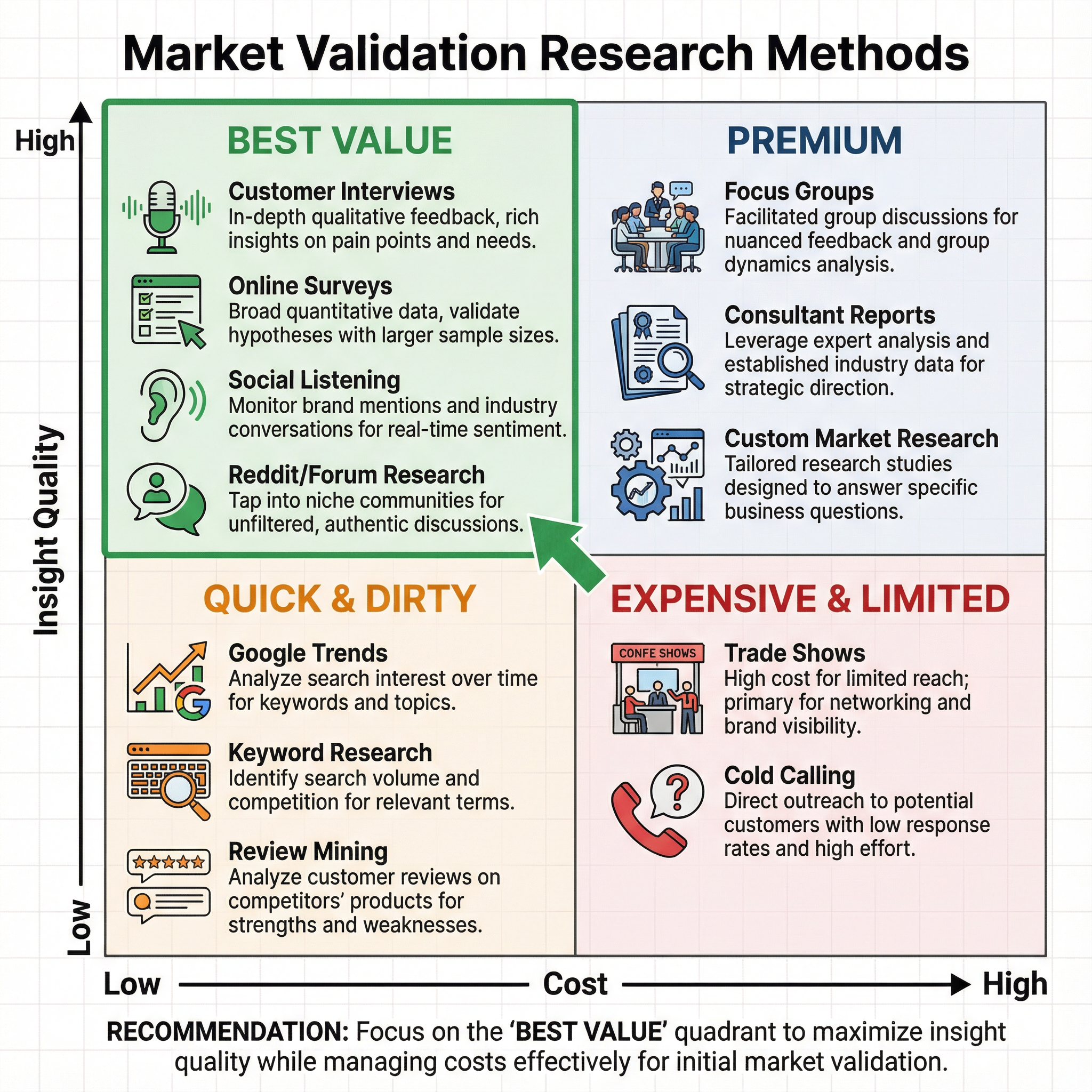
The research methods that work (ranked)
★★★★★ Pre-orders / LOIs
Real money or signed paper. The strongest signal you can get pre-product.
★★★★ Customer interviews
Done with discipline (Mom test), 20+ samples = strong directional signal.
★★★ Landing page conversion
Decent signal if you drive cold traffic, weak signal if you only share in your network.
★★ Surveys
Cheap but full of confirmation bias. Useful only with 100+ responses.
How to know if you actually validated
- 3+ unsolicited customer references to the same specific pain — not just "yeah I'd use that"
- ≥10% conversion on a cold-traffic landing page, OR ≥20% on a warm one
- ≥3 signed LOIs or pre-orders before you've written a feature
- Bottom-up TAM ≥$100M in your serviceable segment
- Founder–market fit: you can't shut up about this problem because you've lived it
"The best validation I've ever seen was a founder who got three pre-orders by sending a Loom video to fifteen people in their network. No deck, no website, just a clear problem and a clear ask."
Sharpen your interview script
Run a simulated discovery round before booking real interviews.
NexTraction's persona panel surfaces the questions a skeptical customer would push back on. Founders who simulate first report 3–5× sharper signal per real interview.
Try a simulated panel →FAQ
How many customer interviews are enough?
20 minimum for B2B (where each interview is dense). 30+ for B2C (where signal is noisier). Stop when new interviews stop surprising you — that's saturation.
What if my market is too niche to find 20 interviews?
Then your first job is distribution research, not solution research. If you can't find 20 people in your market, your TAM is too small for venture scale.
Can I skip validation if I have a strong founder–market fit?
You can shorten it, not skip it. Even seasoned operators get the customer pain wrong. Three weeks instead of six is fine. Zero weeks is reckless.
Conclusion
Validation isn't a hoop to jump through — it's the cheapest insurance you can buy on your own time. Spend four structured weeks now or spend twelve confused months later. Run a structured validation panel to start sharpening your hypothesis today.


