


Top accelerators receive 10,000+ applications per cohort and accept somewhere between 1% and 3% of them. Most founders treat applications like a lottery — they shouldn't. Selection is a structured funnel with knowable patterns. This article unpacks the four stages most top-tier programs run, the signals that move you forward at each step, and the disqualifiers that quietly kill 80% of decent applications.
10,000+
Apps per cohort
1–3%
Top-tier acceptance
4 stages
In the funnel
~6 wks
Total decision time
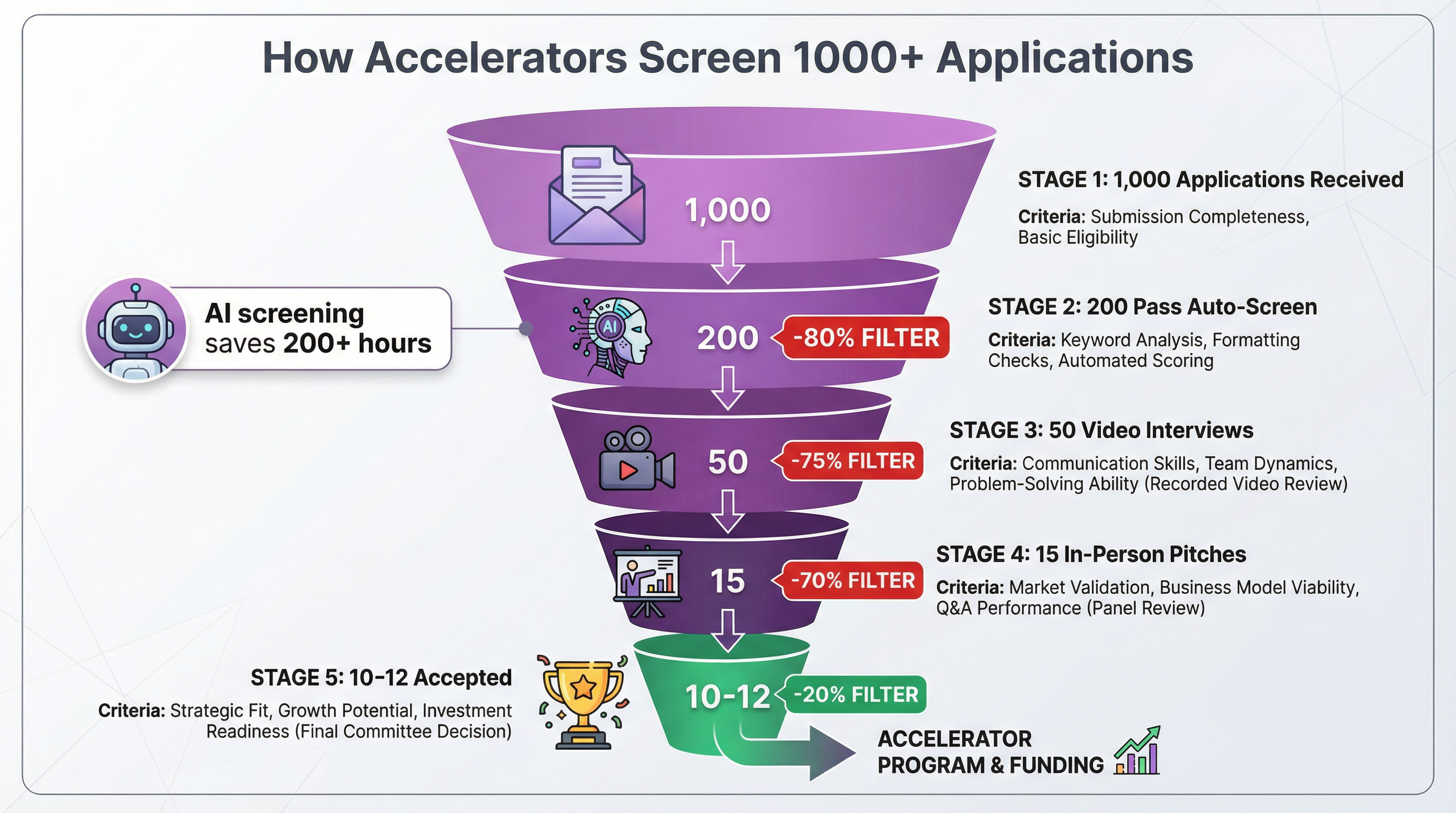
The 4-stage funnel
| Stage | From → To | What's tested | Time |
|---|---|---|---|
| Auto-screen | 10,000 → 2,000 | Disqualifiers, completeness, basic signal | ~1 min |
| Application review | 2,000 → 500 | Insight quality, founder narrative, traction | 5–10 min |
| Video interview | 500 → 150 | Founder energy, clarity under pressure | 15–20 min |
| Final pitch | 150 → 100 | Coachability, culture fit, partner conviction | 30–45 min |
Stage 1 · Auto-screen
The first cut is partly automated. Programs use ML-assisted scoring on text fields (problem clarity, market specificity, traction language) plus hard filters: incomplete applications, deck links that 404, geographic exclusions, stage mismatch. About 80% of applications are killed here — most for boring reasons, not bad ideas.
Stage 2 · Application review
Surviving applications get a 5–10 minute human read. Reviewers look for one thing: insight. Not a fancy idea, not a polished deck — a sentence that proves you've thought about the problem in a way nobody else has. If your application reads like every other application, you're out.
Stage 3 · Video interview
15–20 minutes with one or two associates. The questions are deceptively simple: "Why this?" "Why you?" "What have you built so far?" What they're scoring isn't your answer — it's how fast and clean you can give it. Stumbling on basic questions kills you here.
Stage 4 · Final pitch
30–45 minutes with the partnership. By this point, the technical details barely matter — partners are deciding whether they want to work with you for three months. Coachability is the #1 unspoken criterion. Founders who push back on every question lose. Founders who say "interesting, hadn't thought of that, here's where I'd start" win.
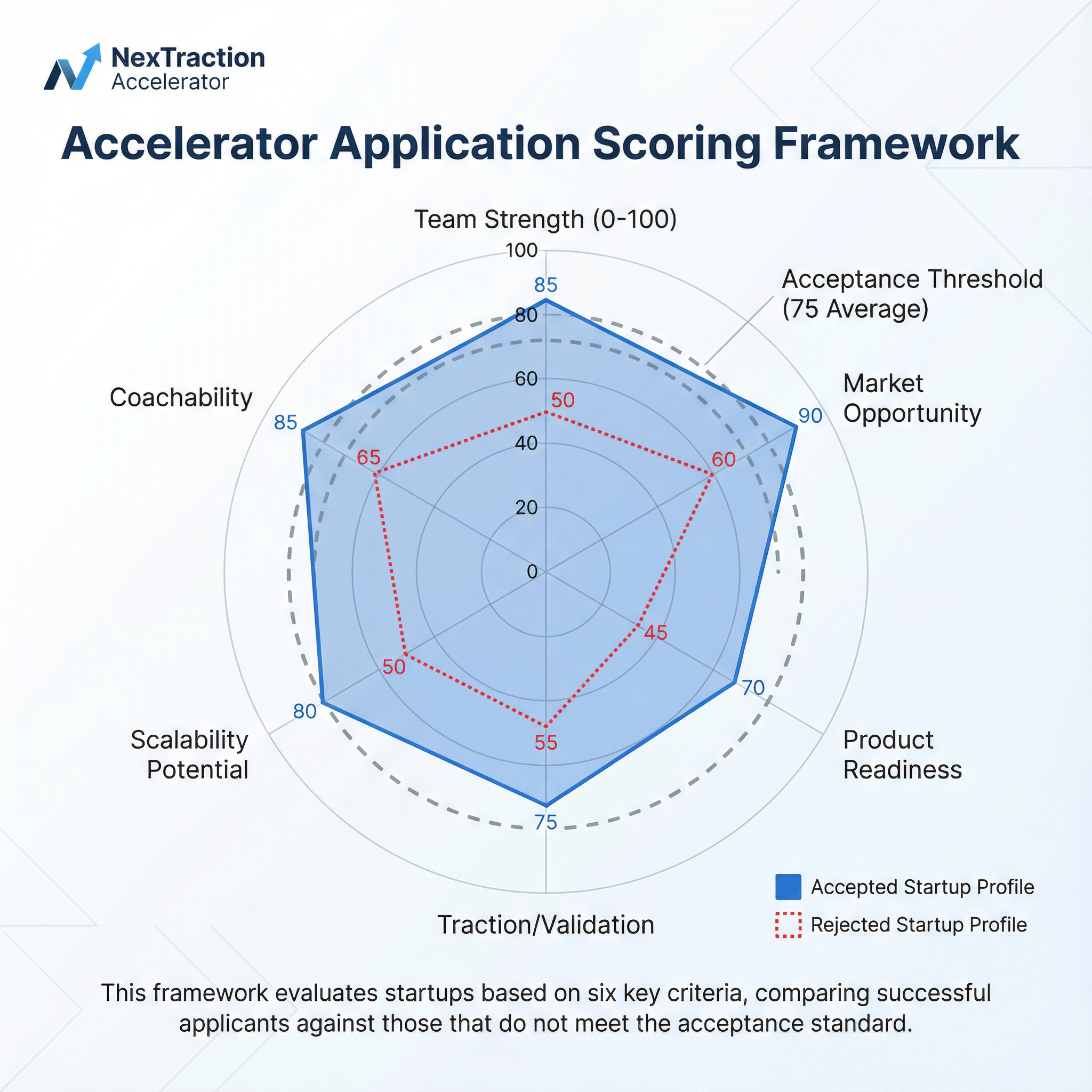
The 6 signals that move you forward
Insight
A non-obvious observation about the problem that proves domain depth.
Velocity
How much progress have you made per week of existence?
Founder–market fit
Why is this team uniquely positioned to win this market?
Concrete artifacts
A working prototype, signed LOIs, real users — anything tangible.
Sharp wedge
One job done extremely well beats ten features done OK.
Coachability
Demonstrated openness to feedback in your application's tone.
The 5 silent killers
Vague problem statements. "We help businesses grow" is not a problem statement. Be specific or get filtered.
Top-down market sizing. If your TAM slide starts with "the global X market is $50B…", you've already lost the reviewer.
Solo founders without distribution. Solo is fine if you have a built-in distribution wedge. Solo without one is a yellow flag.
Buzzword salads. "AI-powered blockchain-enabled marketplace" gets autorejected by humans, not just filters.
Over-rehearsed answers. If you sound like you memorized your application, partners will press until you break.
"The best applications I've read this year were short, specific, and almost boring. The founder had clearly already lived in the problem for years. The worst were polished, vague, and full of acronyms."
Sharpen the application narrative
Get the same scrutiny on your one-pager that an accelerator reviewer will.
NexTraction's deck builder lets you craft and stress-test your application alongside the deck — same workspace, same evidence layer. Find the vague claims and missing wedges before a real reviewer does.
Try the deck builder →FAQ
What's the average acceptance rate?
1–3% for top-tier programs (YC, Techstars, 500). 5–15% for regional or sector-specific accelerators. Acceptance rate is a poor proxy for fit — find programs whose mentor network matches your stage.
Do I need to be incorporated to apply?
Most programs accept pre-incorporation, but you'll need to incorporate before you start. Don't let it be a blocker.
Should I apply to multiple accelerators?
Yes — strategically. Apply to 3–5 programs whose stage and sector fit you. Don't carpet-bomb 20 — reviewers talk to each other and a generic application read by five programs will lose to a tailored one.
Conclusion
Accelerator selection isn't a lottery — it's a process with knowable signals. Spend more time on insight than polish, anchor every claim with a number, and prove coachability before they ask for it. Run your pitch through structured simulation to catch the weak spots before the real reviewer does.


